Quaid-e-Azam and Ameer-e-Millat’s Spiritual Alliance for Pakistan
A Promise to the Nation, A Pledge to God: Jinnah’s Response to Ameer-e-Millat
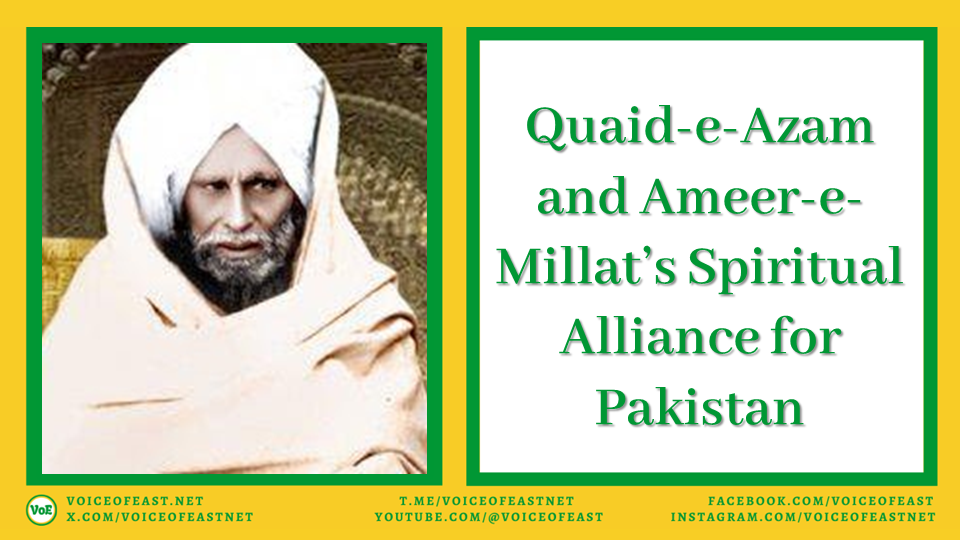
Some wretched fellow once made an abortive attempt to assassinate Quaid-e-Azam Muhammad Ali Jinnah (RH). Before long, Ameer-e-Millat Pir Syed Jamaat Ali Shah (RA) sent a consignment to Quaid-e-Azam, which included a number of gift items, including the Holy Quran ; a prayer mat; a rosary; a shawl; a woollen cloth; and certain other valuables. Ameer-e-Millat (RA) wrote in the letter that accompanied these gifts:
“The nation has selected me as Ameer e Millat, and the invaluable efforts that you have been making for the establishment of Pakistan are truly appreciated, but are basically a part of my job. Nevertheless, I am now a man of over 100 years of age who has been overtaken by physical weakness and frailty. Therefore, you are, in fact, carrying my burden. Yet, I am duty bound to assist you in every possible manner.”
Ameer-e-Millat further urged Quaid-e-Azam to persist with his endeavours and predicted that the Quaid-e-Azam would definitely achieve his goal. In reply, Quaid-e-Azam wrote:
“It is an honour for me to receive the blessings of elders like you, and I can say that I have, sort of, reached the victory stand even at this moment. Let me assure you that no matter what obstacles come in my way, I will not retreat!”
He added:
“Your kind gift of the Holy Quran signifies that I am a leader of the Muslims. It is more than obvious that my leadership would be inconsequential in the event that I am not knowledgeable about the Holy Quran and the Islamic law. I promise that I will study the Holy Quran, for which purpose I have already ordered various English translations and am on the lookout for some religious scholar who can teach me Quranic injunctions in English. Your second gift of the prayer mat denotes that when I do not obey Allah’s commands, how could I expect the public to abide by my directives. I assure you that I will offer my prayers regularly from now on. The gift of rosary demands that I recite benediction and salutation for Prophet Muhammad Sallallahu Alayhi Wasallam. How can Allah’s blessings descend on a person who does not invoke Allah’s blessings for the Holy Prophet (PBUH)? I will certainly comply with this gesture, too.”
Once, while speaking at a huge public meeting, Quaid-e-Azam declared:
“It is my firm belief that Pakistan will definitely come into being, because Ameer e Millat has assured me that this will certainly happen. I have absolutely no doubt that Ameer e Millat’s words will come true with the grace of Almighty Allah.”
Establishment of All India Sunni Conference
The leading Sunni ulema at the meeting at Jami’ah Na’imiah, Muradabad on March 16-19, 1925 set up an organization by the name of Jamiyyat-e-Aliyah-al Markaziah commonly known as All India Sunni Conference (AISC). At its inaugural session, Syed Jamaat Ali Shah was elected its president and the convener of the meeting, Maulana Nazimuddin Muradabadi its Nazim-e-AIa (General Secretary).
The aim and objectives of AISC were:
- To unite the Sunni majority of India on one platform;
- To establish Islamic organizations in every corner of India and link them with AISC;
- To organize missionary activities and to open special seminaries for this purpose;
- To provide religious education to the western educated Muslims and open night schools for the working classes.
- To improve social conditions of the Muslims by encouraging them to invest in trade and business; and
- To fulfil the daily needs of the Muslims by providing them jobs and making them free from the clutches of loans.
The presidential address of Syed Jamaat Ali Shah, which he delivered at the first annual AISC session, holds historical significance. He not only surveyed the political, social and religious problems of the Muslims in the Indian sub-continent, but also highlighted the contemporary issues of the Muslim world. For instance, commenting on the politics of the then Arabia, he condemned the massacre of innocent Muslims in Hijaz carried out by the descendants of King Saud.
In addition, he vehemently criticized the fundamental doctrines of Wahabism, which were fast spreading in India, and were attractive to a considerable section of the Muslim population. In a likewise manner, he also condemned the emergence of other minor sects in Indian Islam. Moreover, he shed light on the calamity of apostasy while upholding the truthfulness of Islam. He also brought to the forefront anti-Islamic customs in the Muslim society and how to avoid them, need for brotherhood among the Muslims and the role and work of the leaders of Ahl-e-Sunnat Wal Jamaat in the preaching of Islam. In addition, he also stressed need for acquiring modern education for Muslims. This first All India Sunni Conference was attended by three hundred ulema, Mashiakh (Sufi pirs) coming from all over India.
The Second All India Sunni Conference was held in Badaun in October 1935 under the presidentship of Jamaat Ali Shah. He was re-elected as its President. In his Presidential address, he highlighted the need for unity among the ulema and common Muslims and the role/responsibilities of ulema in Masjid Shaheed Ganj Movement. While criticizing Ibn-e-Saud’s policies in Arabia, he demanded to respect the sacred places of the Muslims.
The Third All India Sunni Conference was held on 27-30 April 1946 at Benaras under the presidentship of Syed Jamaat Ali Shah which was attended by five hundred Mashaikh, seven hundred ulema and some two Iakh people.
There were reports that some Congress agents conspired to disrupt the meeting. They prepared a resolution according to which Mr. Jinnah was to be denounced as infidel and apostate from the platform of AISC. Moreover, it was demanded of Jamaat Ali Shah to retract his high praise for Mr. Jinnah, or resign from the presidentship of the conference.
It is important to mention here that many nationalist Muslim leaders and nationalist Muslim groups such as Ahrar condemned Muslim League, and denounced its prominent leaders such as Muhammad Ali Jinnah for his westernized and so-called un-Islamic way of life. Now denouncing Jinnah from the platform of AISC and particularly from Syed Jamaat Ali Shah was planned by pro-Congress leaders within AISC. Since Jamaat Ali Shah had a large following among the Punjabi Muslims, the ulterior motive behind the move was to discredit Jinnah among them.
Pir Sahib got wind of the plan but remained cool and calm. When he stood up to deliver Presidential address, he said:
“People dub Jinnah as infidel, but, I call him a saint, people express their own opinion but I say it in the light of Quran and Hadiths. Those who believe in their Allah and obey Him Allah creates love and reverence for them in the hearts of people’ (Quran). Now is there anybody other than Jinnah who is loved and respected by ten crore Muslims of India? Therefore, you may call him infidel, but in my eyes he is a Saint”.
After these arguments, nobody dared to pressurize him to change his stance.
In the same meeting, a resolution was also passed, whereby the leaders of the AISC and other prominent leaders present in the meeting pledged to support the demand for Pakistan.
Discover more from Voice of East
Subscribe to get the latest posts sent to your email.
Categories: History, Pakistan, Quaid-e-Azam, Spirituality
 Voice of East
Leave a Reply