CCG Report Warns Of Deepening Alienation And Silenced Voices In Kashmir
CCG finds Kashmir gripped by a climate of “sullen silence”
Washington, D.C. – It is an established fact that human rights are being violated on a daily basis across every part of Jammu and Kashmir. Multiple international human rights organizations and United Nations Special Rapporteurs have documented the absence of meaningful freedom of expression in Jammu and Kashmir. Independent civil society findings indicate widespread censorship, intimidation, arbitrary detention, and harassment of journalists, civil society members, religious leaders, and ordinary citizens. Speaking openly about developments in the region carries a high risk of detention under laws such as the Public Safety Act (PSA) and the Unlawful Activities (Prevention) Act (UAPA).
Local Kashmiris continue to face humiliation, intimidation, and harassment at the hands of Indian military and paramilitary forces. These findings have been independently verified by a well-respected and reputable New Delhi–based organization, the Concerned Citizens Group (CCG). The CCG comprises prominent and distinguished Indian political leaders, retired senior military officials, and representatives of civil society.
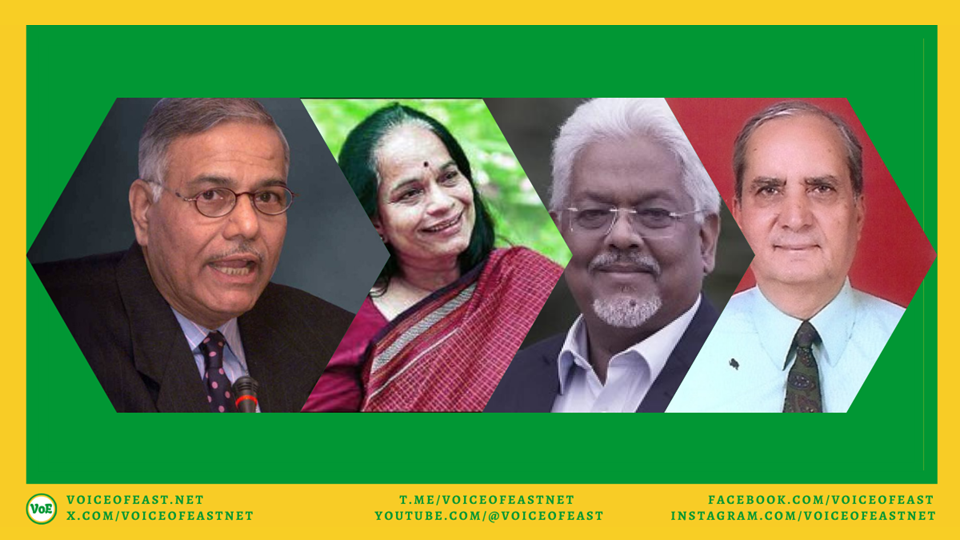
The group visited Jammu and Kashmir from October 28 to 31, 2025, and subsequently released its 11th report on the region. Members of the delegation included Yashwant Sinha, former Minister of Finance and Minister of External Affairs of India; Sushobha Barve, Executive Director of the Centre for Dialogue and Reconciliation; Air Vice Marshal (Retd.) Kapil Kak, a Kashmiri by birth and former Deputy Director at the Centre for Air Power Studies; and Bharat Bhushan, one of India’s most seasoned journalists.
The CCG categorically emphasized that it has no affiliation with the Government of India or with any political party. Its visits to Jammu and Kashmir are entirely self-financed by its members, and it does not solicit contributions from any organization, including NGOs.
The CCG was formed in the aftermath of the large-scale protests that erupted in the Kashmir Valley in 2016. Its stated mission is to act as a bridge between Jammu and Kashmir and the rest of India. The primary objective of its recent visit was to gauge the public mood at the grassroots level and to convey to the wider Indian public the genuine sentiments of the people of Jammu and Kashmir.
According to the report, the activities of the CCG were significantly restricted by the police. The group sought to meet a broad cross-section of society to obtain an objective and accurate assessment of the prevailing situation but was prevented from doing so. In several instances, police reportedly instructed individuals not to appear before the CCG. Despite these constraints, the delegation managed to meet senior leadership of the National Conference, Indian National Congress, and the Communist Party of India (Marxist), as well as representatives of the Kashmir Chamber of Commerce and Industry, the Jammu and Kashmir Students’ Association, and members of the media. Additionally, they met Mirwaiz Umar Farooq, a prominent Muslim religious leader, and Sanjay Ticku, a well-known Hindu leader.
The report describes a pervasive atmosphere of “sullen silence” in Kashmir, noting that “alienation has deepened” and that “resentment and anger against the Central government have increased.” It further concludes that the reality on the ground is “far removed from the narrative presented by the Government of India and its media outlets based in Delhi.”
Echoing findings of other international human rights organizations and UN Special Thematic Rapporteurs, the CCG report confirms the near-total absence of freedom of expression in Kashmir. The media remains muzzled, and reporting on alleged atrocities committed by Indian security forces is treated as a criminal offense, often leading to arrest and imprisonment. The report observes:
“There is a pervading fear of voicing any dissenting views or opinions among civil society members. Repression by the police is real and does not spare public intellectuals, media persons, or others.”
One prominent doctor told the delegation, “We have been silenced. But this eerie silence does not mean that all is well.” He warned that a “volcano of suppressed anger and frustration, bordering on hatred, could erupt at any time—it only needs a trigger.”
The report also documents testimonies from academics and civil society representatives who stated that Kashmiri identity is gradually being erased, that ordinary Kashmiris are routinely rebuked and abused, and that economic exploitation has intensified.
A particularly alarming assessment highlights that prolonged uncertainty has pushed many Kashmiri youth toward anger, alienation, substance abuse, and even radicalization—developments that are profoundly destructive to a society historically known for its cultural harmony and serenity. Reflecting this concern, a senior editor warned that “the silence of Kashmiri society is unsustainable. When it breaks, the consequences could be dangerous.” A political leader quoted in the report remarked ominously, “Kuch bada hone wala hai” (“Something big is going to happen”).
The report further documents blatant religious interference. Even Mirwaiz Umar Farooq, the Chief Imam of Kashmir, is reportedly denied the freedom to deliver sermons without prior police approval. Authorities allegedly demand advance submission of his khutbas and details of religious ceremonies he intends to officiate—an unmistakable intrusion into religious affairs.
A young professional summarized the prevailing governance structure starkly: “Kashmir is a colony of the Viceroy.” According to this account, the elected government is largely powerless, with no effective control over law and order, while real authority rests with the Lieutenant Governor appointed by New Delhi.
After extensive consultations, the CCG concludes that the people of Kashmir are experiencing a “deep sense of loss—of identity, sub-identity, dignity, and honour.” The report also details ongoing censorship, surveillance, intimidation, and harassment of media organizations. During Operation Sindoor, reporting became entirely state-controlled, severe restrictions were imposed on local journalism, and many reports filed by Kashmiri journalists were allegedly suppressed. Journalists are even denied access to report on legislative assembly proceedings due to the refusal of accreditation passes. Journalists face intimidation, harassment, and removal of reports critical of authorities. Reporting on alleged abuses by security forces is treated as a criminal offense.
In conclusion, these findings directly engage obligations under the International Covenant on Civil and Political Rights (ICCPR) and merit continued attention by the UN Human Rights Council, Special Rapporteurs, and relevant UN mechanisms. Therefore, we demand the immediate release of all political prisoners and detainees held for peaceful expression, including Muhammad Yasin Malik, Shabir Ahmad Shah, Masarat Aalam, Khurram Parvez, Dr. Hameed, Fayaz, Aasia Andrabi, Sofi Fehmeeda, Nahida Nasreen and others; restore press freedom, guarantee freedom of expression, uphold freedom of assembly and association, end interference in religious practices and above all; guarantee of the right of self-determination of the people of Jammu and Kashmir so as to live with dignity and honour.
Discover more from Voice of East
Subscribe to get the latest posts sent to your email.
Categories: Kashmir
Related Articles
-
 Children’s Rights Under Occupation: A Call To Action For Kashmir At The CRC’s 100th Session
-
 The Persistence Of Occupation: Kashmir And The Silence Of International Actors
-
 Will Kashmir’s Liberation Trigger India’s Disintegration?
-
 OIC Rallies Global Support For A Just And Lasting Resolution In Kashmir
 Voice of East
Leave a Reply