US Neo‑Monroeist Offensive Strangling Cuba Risks Blowback At Home
By Uriel Araujo
As Trump escalates economic warfare against Cuba, the administration revives a familiar regime-change logic rooted in pressure and economic strangulation. History teaches that such strategies deepen suffering without guaranteeing regime collapse. The consequences may reverberate far beyond Havana, reshaping US relations across Latin America and ethnopolitical relations at home.
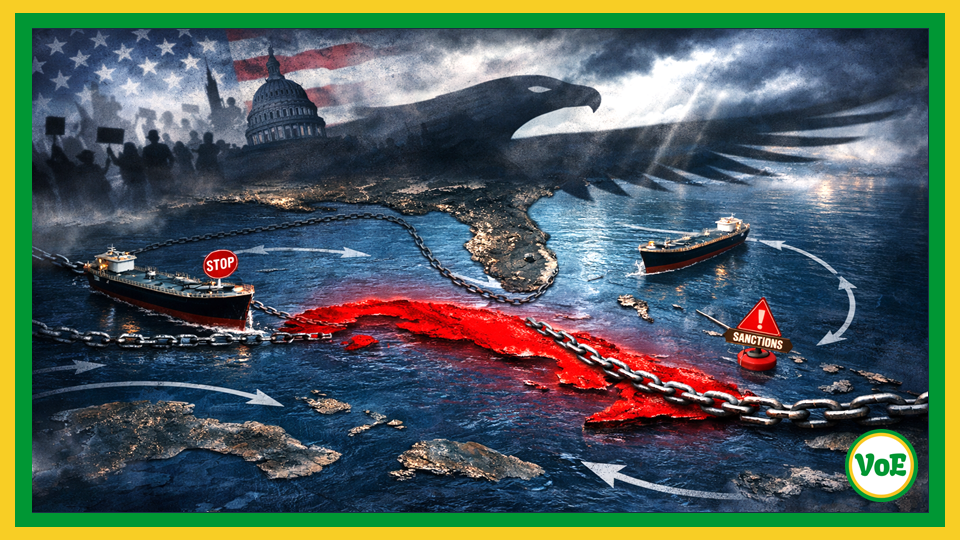
US President Donald Trump has just escalated Washington’s long-standing economic war against Cuba by declaring a “national emergency” (another one!) aimed at sanctioning and tariffing any country that supplies the island with oil. Mexico, potentially Cuba’s largest supplier after Venezuela’s operations were curtailed, has already temporarily suspended shipments. The goal is clear enough: to push the Cuban economy over the edge, generating social unrest, and thereby pushing regime change.
There has long been an American embargo but one should not presume this is merely a tightening of it; rather, it is an attempt at full-spectrum economic asphyxiation this time.
Havana has responded predictably: President Miguel Díaz-Canel rejected Trump’s threats to “make a deal before it is too late,” insisting that “no one tells us what to do,” while Cuban officials warn that a complete fuel cut-off would be catastrophic for infrastructure and basic services. Experts warn that this would amount to a real blockade, with tremendous humanitarian consequences.
This escalation is part of a broader pattern in Trump’s second presidency, with hawkish Marco Rubio as Secretary of State: I’ve been describing it since 2024 as neo-Monroeism. It marks a new stage in Washington’s continental security doctrine, blending counterterrorism rhetoric, narco-politics, and elastic justifications for power projection across Latin America and the Caribbean.
Thus far, naval build-ups in the Caribbean, sanctions, and threats have been targeting Cuba, without signs of a plan to invade, but history suggests that intimidation often precedes escalation: we’ve seen this with Venezuela, recently, where there has been no occupation so far, but a military invasion to kidnap the President, and possible covert CIA and special forces presence/infiltration.
Cuba sits squarely within this New Cold War dynamic. Washington’s pressure campaign is unfolding against the backdrop of growing Chinese economic and technological engagement in the Caribbean, something I pointed out back in 2020. US dominance in the Caribbean had been near-total since 1898, and any erosion of that status is perceived in Washington as intolerable. From Washington’s perspective, strangling Cuba economically is also about signalling to Beijing that the Caribbean remains an American lake.
It is true that, domestically, Cuba is vulnerable. Years of sanctions, compounded by the loss of Venezuelan oil subsidies plus internal problems and failures have produced blackouts, inflation, collapsing tourism, and mass emigration. The island has been in crisis for a while, and the American expectation is that economic collapse will translate into political collapse. That expectation has repeatedly failed, however.
Christopher Sabatini, a Chatham House researcher, cautions that Cuba is not Venezuela. The regime is more cohesive, the security forces more disciplined, and there is no solid organized political opposition ready to step in (even in Venezuela the Bolivarian regime is still in power). A Maduro-style abduction attempt would likely be a disaster. Limited strikes against infrastructure would achieve little and the targeting of Chinese-linked civilian facilities would risk provoking Beijing too much.
This being so, Washington’s choice seems to be collective punishment: cut oil, cut remittances, tighten finance, and hope protests erupt (critics could describe this logic as terrorist-like). If this works, US “support” could follow, masked as humanitarianism.
Sahasranshu Dash (research associate at the ICAEPA) goes further, arguing that Cuba is back on Washington’s regime-change agenda precisely because Venezuela has apparently been “neutralized”.
The logic here is circular and symbolic: sanctions deepen suffering, suffering drives migration, and migration is then used as proof of “regime’s failure”, justifying further escalation. Politics of memory is also reinforced by influential sectors of the Cuban-American diaspora (nearly 3 million people), which also includes networks historically intertwined with US intelligence and organized crime, the so-called Miami Mafia. The result is a self-reinforcing cycle that risks pushing Cuba into outright collapse.
From the American regime’s perspective, this strategy may also backfire at home, however. Despite some significant Cuban-American support for intervention, Trump’s neo-Monroeism, should it escalate, risks alienating Latins more broadly. This is a demographic that was crucial to his own 2024 victory.
In January 2025, I warned that Trump’s aggressive posture toward neighbouring Mexico could produce domestic ethnopolitical consequences, including protests and electoral backlash. In November 2024, Trump won an unprecedented 43 percent of the Latino vote, a figure that should not be taken for granted. Mexican-Americans alone accounted for 11.2 percent of the US population in 2022, and the broader Hispanic population (who have relatives abroad) may very well see Washington’s actions in Cuba, Venezuela, Colombia, and beyond as a pattern of anti-Latino hostility rather than isolated cases.
With protests and a general strike against ICE abuses already flaring, economic anxieties growing, and scandals such as the horrific Epstein files affair haunting the administration, a blatantly aggressive policy toward Latin America risks deepening domestic polarization.
Add to this Trump’s threats toward Iran, Greenland, and others, and the contradiction with MAGA’s promised “America First” isolationism becomes hard to ignore. In other words, this approach may yet prove self-defeating: aggressive enough abroad, destabilizing enough at home.
To sum it up, Washington has been trying to overthrow Cuba’s socialist system for over six decades. It has failed every time. There is no guarantee that oil strangulation and tariff warfare will succeed where invasions, sabotage, and covert operations did not. What they are certainly likely to produce, once again, is humanitarian suffering, migration flows, and geopolitical openings for Washington’s rivals.
Even if the Cuban regime might end up falling, the real question should be whether the United States is prepared for the consequences of pursuing this line of action in Cuba and elsewhere in Latin America, with all the human cost potentially involved (especially if military options are employed). The US itself is increasingly a Latin American country, after all.
Uriel Araujo, Anthropology PhD, is a social scientist specializing in ethnic and religious conflicts, with extensive research on geopolitical dynamics and cultural interactions.
Disclaimer: The views expressed in this article are author’s own and do not necessarily reflect the editorial policy of Voice of East.
Discover more from Voice of East
Subscribe to get the latest posts sent to your email.
Categories: Analysis, Geopolitics, International Affairs
 Dmitry Trenin, A Top Russian Expert Issues A Clarion Call For Correcting Foreign Policy Misperceptions
  The Moment Of Truth Is Arriving In Russian-Armenian Relations
  The West Is Encircling Russia In The South Caucasus And Central Asia
  The US Is Making A Play For Belarus’ Most Strategic Export
  Voice of East
Leave a Reply