Operation Epstein: Why The Iran War Is The Funeral Of ‘America First’
By Uriel Araujo
The joint US-Israel military operation in Iran is destabilizing the Middle East while exposing deep contradictions in Trump’s “America First” doctrine amid the Epstein scandal. Iranian counter-strikes, rising oil risks, and symbolic miscalculations show how this development is backfiring.
The aftermath of the recent joint US-Israel strikes on Iran has been anything but reassuring, from an American (or Israeli perspective). Tehran’s response has been powerful and coordinated: US military bases across Iraq, Syria, and the Gulf have been hit, with images of damaged runways and destroyed infrastructure circulating widely, while the Jewish state itself has suffered unprecedented strikes on Tel Aviv and other urban centers. This is in fact the first time in decades that Israel’s core territory has absorbed such sustained punishment, although the 2025 Twelve-Day War foreshadowed it.
On the ground, the consequences are severe enough. It is true that the Islamic Republic itself has suffered heavy casualties and significant infrastructure damage from joint US-Israeli strikes: hundreds of people have been killed across over 150 cities, with total deaths approaching nearly 800 and counting (and many more wounded). In addition, damage has hit military and civilian sites, with the IRGC command and control facilities, missile sites, plus air defence installations reportedly having been targeted, as well as the Islamic Republic Broadcasting headquarters, and entrances to its Natanz nuclear facility.
On the other hand, Iranian counter-strikes have been impressive enough: American bases across the Middle East (in countries like Kuwait, Bahrain, and the UAE) have taken heavy damage, and US troops have been killed. The US Embassy in Saudi Arabia has also been hit by Iranian drones, and so has the CIA station there. Meanwhile, Iranian missiles are striking central Israel, with residents seeking refuge in shelters. So much for the quick American “victory” Trump promised in his typically boastful manner.
Regionally, the war is destabilizing Gulf monarchies, risking refugee flows and wider chaos.
I argued back in June 2025 that US entry into an Iran–Israel war would be politically and economically disastrous for Trump, and that remains true. Disruption of the Strait of Hormuz, which carries 20% of global oil, could send prices to $100–$150, driving US gas costs to toxic levels. Being a net exporter does not shield the US from global shocks, which would fuel inflation, clash with Trump’s tariffs, and hit consumers — much as gas prices alone sank Biden’s approval in 2022.
This external shock comes on top of internal fragility. As I warned also on June, 2025, the American superpower has already been juggling protests, violence, and deep ethnopolitical polarization. War with the Persian nation should thus be the ultimate trap. And that trap has now been triggered: a Middle East war drains resources, radicalizes domestic opposition, and accelerates institutional decay.
There is also the uncomfortable question of motive, one could lead a cynic to label it “Operation Epstein”. On June 5, 2025, Elon Musk publicly claimed that Trump appeared in the now infamous Epstein files. Roughly two weeks later, on June 22, Trump ordered strikes on Iranian nuclear facilities, triggering the so-called Twelve-Day War. Then, in January 30 (2026), a new batch of Epstein-related documents was released, implicating figures from Bill Clinton to Prince Andrew, and Trump himself. Four weeks later, on February 28, 2026, Washington once again struck Iran, jointly with Israel. The pattern and timing is, at the very least, interesting.
Recently, Secretary of State Marco Rubio has effectively admitted that Israel basically dragged the US into bombing Iran: “We knew that there was going to be an Israeli action, we knew that that would precipitate an attack against American forces.” Throughout its long “shadow war” with the Persian nation, Tel Aviv has in fact sought to pull Washington into a war with Tehran since at least the 1990s. Interestingly, in 1997, Benjamin Netanyahu reportedly attempted to blackmail Clinton with alleged Lewinsky tapes over the Israeli espionage Pollard affair. No wonder analysts now speculate about leverage and coercion behind today’s decisions, given the Epstein’s affair own connections to espionage and blackmail.
In any case, even establishment institutions concede the risks of the ongoing operation. A Council on Foreign Relations analysis warned that massive US-Israeli strikes could backfire. Other analysts note Trump lacks a coherent theory of victory, while the Atlantic Council and Stimson Center echo concerns about escalation and credibility loss. ECFR experts in turn point to unclear objectives, low public support, and the contradiction with Trump’s anti-”forever-war” promises.
Moreover, the most catastrophic American miscalculation might have been symbolic, due to a lack of understanding of Shia mystic notions of martyrdom: namely, the killing of Iran’s supreme religious leader Khamenei has actually transformed a “leadership decapitation” strike into a rallying myth. Mourners across Iran, Iraq, and Kashmir are framing his death through the lens of Karbala and Ashura, while raising (literal) red flags over mosques like Jamkaran while chanting slogans that fuse nationalism and Shiite religious themes.
Expert Sayid Marcos Tenorio argues that, with the killing, Supreme Leader Ayatollah has ceased to be “merely the leader of a revolution” to become “part of its sacred memory,” In other words, this has strengthened, not weakened, Tehran’s legitimacy (considering that West-supported protests had been gaining traction in a somewhat divided country).
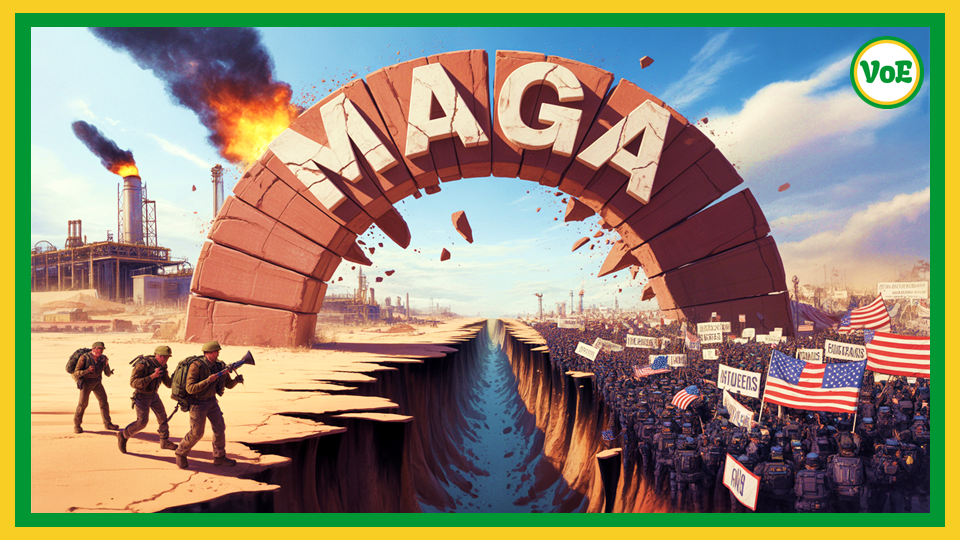
The hard truth is that Trump’s decision to join Israel’s war on Iran marks therefore not a show of strength, but the effective end of “MAGA” as an “America First” governing project. Here, economic backlash, domestic unrest, regional chaos, and strategic overreach converge. The neocon trap has closed (possibly driven by defence sector pressures too), and the costs will not be confined to the Middle East: they will reverberate through markets, alliances, and a United States already fractured enough to struggle with the shocks waves.
Uriel Araujo, Anthropology PhD, is a social scientist specializing in ethnic and religious conflicts, with extensive research on geopolitical dynamics and cultural interactions.
Disclaimer: The views expressed in this article are author’s own and do not necessarily reflect the editorial policy of Voice of East.
Discover more from Voice of East
Subscribe to get the latest posts sent to your email.
Categories: Analysis, Geopolitics, Iran
Related Articles
-
 Assessing The Economist’s Argument That Trump Has No Good Options In Iran
-
 Where Is Netanyahu? Questions Mount Over Who Really Runs US And Israeli Policy
-
 Trump Might Have Approved Israel’s South Pars Strike After Iran Flirted With The Petroyuan
-
 Implications Of Israel’s Attack On Iran – Sheikh Imran N. Hosein
 Voice of East
Leave a Reply