How Likely Is It That The US Will Contain Turkiye After It’s Done With Iran?
It probably won’t since Turkiye helps advance American interests at the crossroads of Afro-Eurasia in Iran, the Middle East-North Africa, and along Russia’s entire southern periphery.
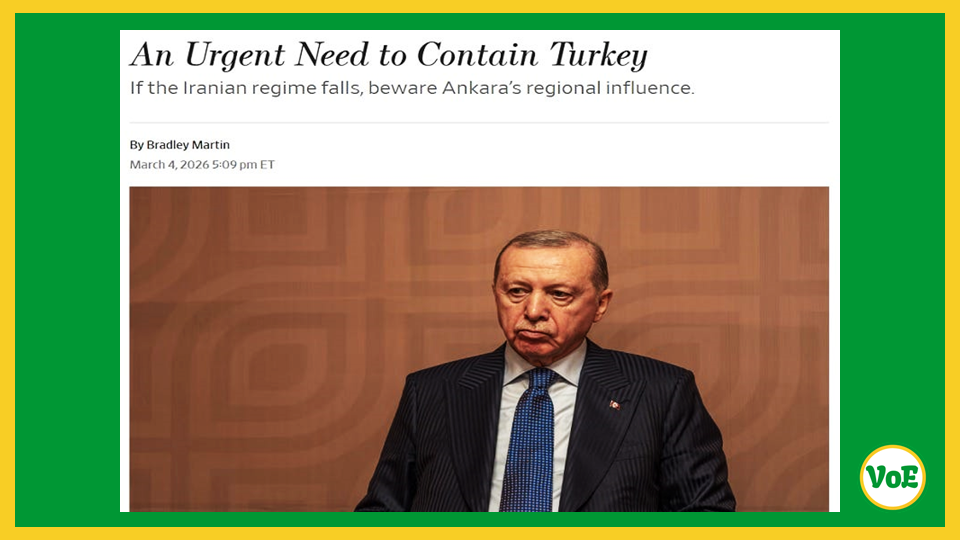
The Wall Street Journal published an opinion piece last week titled, “An Urgent Need to Contain Turkey”, which warned that “If the Iranian regime falls, beware Ankara’s regional influence.” The author is Bradley Martin, who’s Executive Director of the Near East Center for Strategic Studies and used to be a Senior Fellow with the news and public policy group Haym Salomon Center and deputy editor for the Canadian Institute for Jewish Research. He also contributes to the Jerusalem Post and Jewish News Syndicate.
His credentials thus led to some interpreting his article as Israel lobbying the US to contain Turkiye after the end of the Third Gulf War that was sparked by their joint attack against Iran. Whatever one’s opinion about the intention of his latest article and his speculative ties with the State of Israel may be, he argues that Turkiye must ultimately be contained because it “opposes U.S. foreign policy and is a headache for its allies.” Several examples are cited in support of this claim for justifying his post-war policy proposal.
These are President Recep Tayyip Erdogan’s opposition to the US’ war against Iran, his government’s ties with ISIS during the apex of its power, and its weaponization of the 2015 Migrant Crisis against the EU. What Martin didn’t mention, however, is Erdogan’s belief that the US colluded with his late American-based rival Fethullah Gulen to orchestrate summer 2016’s failed coup attempt. Turkish-US relations are therefore much complicated than he made them seem.
His oversimplification of them is obviously due to him wanting to manipulate his targeted American audience into supporting Turkiye’s post-war containment, but the argument can be made that regardless of whatever one thinks about the abovementioned examples, Turkiye’s expansion actually helps the US. For starters, it could launch a military intervention in Iran on the grounds of either targeting armed Kurdish rebels that it considers to be terrorists or helping its ally Azerbaijan, which might intervene first.
Even if that scenario doesn’t transpire, Turkiye reportedly plans to join the so-called “Islamic NATO”, whose core presently consists of September’s mutual defence alliance between Saudi Arabia and Pakistan. Whether or not it formally does so, Turkiye can still coordinate with those two and Egypt (another country with which Saudi Arabia might enter into an alliance) across the broad Middle East-North Africa (MENA) space, with all four US allies (each to varying legal extents) advancing its aims there.
Even in the absence of the aforesaid, Turkiye is now poised to expand Western – including NATO – influence along Russia’s entire southern periphery in the South Caucasus, the Caspian Sea, and Central Asia through last August’s “Trump Route for International Peace and Prosperity” (TRIPP). Unaware readers can learn more about how TRIPP threatens Russia’s national security here, which links to five other analyses about this, but it’s suffice to say that this is arguably the next front for containing Russia.
These three roles make Turkiye one of the US’ most strategic allies due to its ability to advance American interests at the crossroads of Afro-Eurasia. The US is accordingly unlikely to contain Turkiye after it’s done with Iran, but Israel might try to do so since it feels very uncomfortable with Turkiye’s rise as the most powerful Muslim country, possibly soon with its own ballistic missile and even nuclear programs too. Martin is therefore lobbying to advance Israeli interests over American ones even if unintentionally.
Disclaimer: The views expressed in this article are author’s own and do not necessarily reflect the editorial policy of Voice of East.
Discover more from Voice of East
Subscribe to get the latest posts sent to your email.
Categories: Analysis, Geopolitics, International Affairs, Iran
 Commodities Over Principles: The Economic Logic Behind The UNSC Vote On Iran
  Iran’s Strikes On The UAE Exposed The Limits Of BRICS Unity
  How US Military Action Against Iran Serves The Grand Strategy Of Containing China
  A Venezuelan‑Style Iran Oil Blockade Could Let The US Divide And Rule RIC
  Voice of East
Leave a Reply