Sacrificing Seoul For Tel Aviv: The Global Geopolitical Ripple Effects Of The Iran War
By Uriel Araujo
The redeployment of THAAD defences from South Korea to the Middle East reflects the widening geopolitical shockwaves of the Iran conflict. While Seoul diplomatically seeks to minimize it, the episode highlights US strategic overstretch and shifting alliance dynamics. Across Asia, debates over security dependence and multi-alignment should intensify.
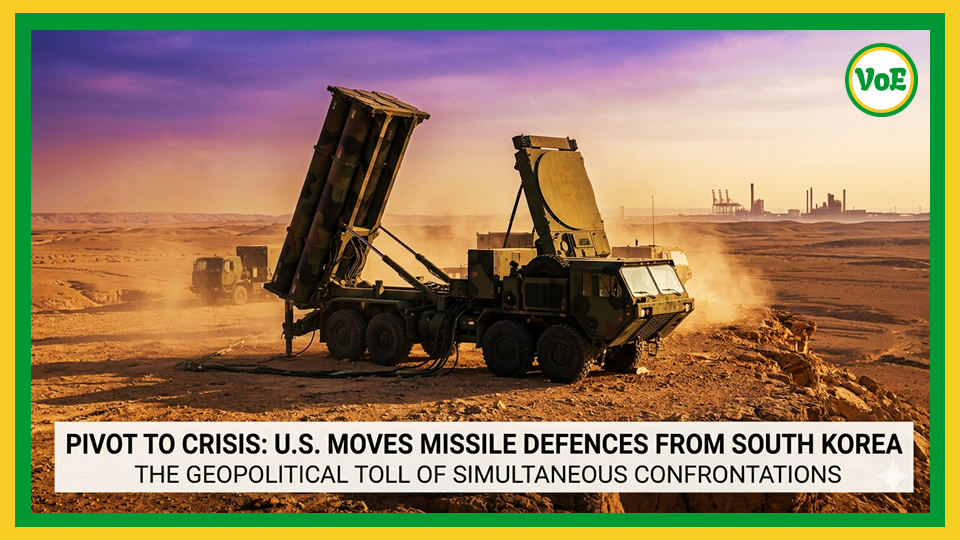
The ongoing war against Iran jointly pursued by Washington and Israel is already producing geopolitical ripple effects far beyond the Middle East. One of the most telling developments arguably emerged this week, with the partial redeployment of US missile defence systems from the Korean Peninsula to the Middle East. Reportedly, elements of the THAAD system stationed in South Korea are being transferred to reinforce regional defences amid the escalating conflict in Iran.
The move, possibly accompanied by Patriot batteries, reflects Washington’s urgent need to reinforce missile defences around Israel and US assets in the Gulf, thus alarming sectors of the South Korean political and military elite.
This redeployment in fact also highlights a deeper structural problem: the United States is attempting to manage multiple theatres of confrontation simultaneously while possessing finite defensive resources. And the consequences are now being felt in Northeast Asia: from a “Western” point of view, removing or even partially relocating THAAD from South Korea arguably creates exposure by weakening the peninsula’s upper-tier ballistic missile defence, thereby potentially opening a high-altitude interception gap against North Korean missiles.
South Korean President Lee Jae Myung has publicly downplayed the issue, stating that deterrence remains credible thanks to layered defences, US troops on the peninsula, and existing alliance mechanisms.
Be as it may, the symbolism and political message is clear enough. Critics in Seoul have already voiced concern that the redeployment signals wavering US commitment to Northeast Asian security while Israel-driven Washington prioritizes Middle Eastern crises. South Korea may officially accept the decision: it cannot block it, anyway, meaning: when strategic priorities collide, secondary allies must adjust.
This development should also be understood within the broader global consequences of the Iran war. I recently wrote about how the conflict is generating worldwide repercussions, from oil market volatility to regional instability across Eurasia. Iran has demonstrated resilience and the risk of a very prolonged conflict is real enough.
The THAAD redeployment illustrates precisely that overstretch. In addition to its neo-Monroeist pivot to the American continent (see Cuba and Venezuela, not to mention the war on drugs in Mexico), Washington now finds itself balancing commitments in the Middle East, Europe, and the Indo-Pacific. Moreover, this takes place while confronting adversaries across all these regions simultaneously (and the line between adversary and “ally” is often blurred, as we have seen with Greenland). The limits of missile defence assets in any case have become visible. Systems deployed in one theatre cannot be instantly replicated elsewhere.
From Seoul’s perspective, the implications are quite serious. The peninsula remains one of the most militarized regions in the world, and any perceived weakening of the missile defence architecture may alter strategic calculations. Even if the gap proves temporary, the political signal still matters.
One may recall that during Trump’s first administration tensions with North Korea briefly eased through direct diplomacy. Whatever one thinks of those negotiations, they demonstrated that engagement could lower immediate risks. By contrast, the Biden years largely abandoned that approach, treating negotiations primarily through the lens of denuclearization demands that Pyongyang of course had little incentive to accept.
As I argued previously, a more realistic approach to the Korean Peninsula (even from an American perspective) would recognize that North Korea’s nuclear capability is a permanent strategic fact and, accordingly, seek mechanisms to manage it rather than try to eliminate it.
In that context, regional dynamics have evolved rapidly. Cooperation between Russia and North Korea, for instance, has expanded within a broader Eurasian strategic landscape.
Meanwhile, Washington’s own Indo-Pacific strategy has already contributed to an accelerating missile race across the region. Deployments and defence initiatives involving Japan, the Philippines, Australia and others have intensified the militarization of the region, thereby raising the risks of miscalculation and escalation.
The redeployment of THAAD demonstrates a hard truth: even this expanding network cannot fully compensate for limited resources.
The irony is that the Korean Peninsula itself has been drawn into Washington’s evolving alliance architecture. Discussions about an “AUKUS-plus” framework including South Korea, along with debates about nuclear-submarine cooperation, illustrate how Seoul has been encouraged to deepen military integration with US-led structures. Yet the current episode suggests that alliance commitments remain quite conditional when global crises emerge elsewhere, especially given the complexity of the US-Israeli special relationship.
No wonder some Asian policymakers increasingly consider multi-alignment strategies. Countries such as Indonesia have already experimented with more flexible diplomacy, maintaining relations across rival blocs rather than relying exclusively on one security patron. For many emerging states navigating the new Cold War environment, such pragmatism appears reasonable.
That being said, the Iran war will likely accelerate that very trend. Washington’s decision to escalate alongside Israel has already produced worldwide economic and strategic repercussions, as mentioned. Energy markets are volatile, shipping routes face disruption, and regional tensions extend from the Persian Gulf to Eurasia. The redeployment of missile defences from South Korea is yet another example of how this conflict reverberates globally. For US allies, it also shows that, when Washington engages in simultaneous confrontations, priorities shift rapidly, to say the least.
Seoul has responded cautiously, emphasizing alliance stability and minimizing public criticism. Diplomatically, that restraint is understandable. Yet strategically the lesson should not be ignored.
If the United States is willing to redeploy critical defences from the Korean Peninsula in order to support a Middle Eastern war, Asian governments may conclude that diversification of partnerships is prudent or necessary. Reliance on a single security provider, especially one as unpredictable as Washington, becomes rather risky in an era of global instability.
To sum it up, the THAAD episode is a geopolitical signal in itself. It tells the world how overburdened Washington has become, how quickly alliance priorities can shift, and how urgently Asian states must rethink their strategic autonomy.
Uriel Araujo, Anthropology PhD, is a social scientist specializing in ethnic and religious conflicts, with extensive research on geopolitical dynamics and cultural interactions.
Disclaimer: The views expressed in this article are author’s own and do not necessarily reflect the editorial policy of Voice of East.
Discover more from Voice of East
Subscribe to get the latest posts sent to your email.
Categories: Analysis, Geopolitics, International Affairs
Related Articles
-
 Five Reasons Why The US Declined To Enforce Its De Facto Blockade On Cuba For Russia
-
 Why The South Caucasus Is No Safe Corridor To Bypass Russia
-
 Trump 2.0’s Vision Of “NATO 3.0” Perfectly Aligns With All Of The Administration’s Policies
-
 Why The Kremlin Views US ‘Opposition’ To Poland’s Nukes As A Feint
 Voice of East
@voiceofeast.net South Korea's extended deterrence calculus has been changing quietly since 2017. the Iran war does not change the math, it just makes the conversation less hypothetical.
LikeLike