Fuel, Food, And Fragility: How the American-Israeli War With Iran Is Alienating The Global South
By Uriel Araujo
The Global South faces rising inflation, food insecurity, and debt risks as the Iran war disrupts global markets. Oil price spikes and potentially tighter monetary policy in the West are bound to amplify economic strain. A growing sense of injustice should reshape geopolitical alignments.
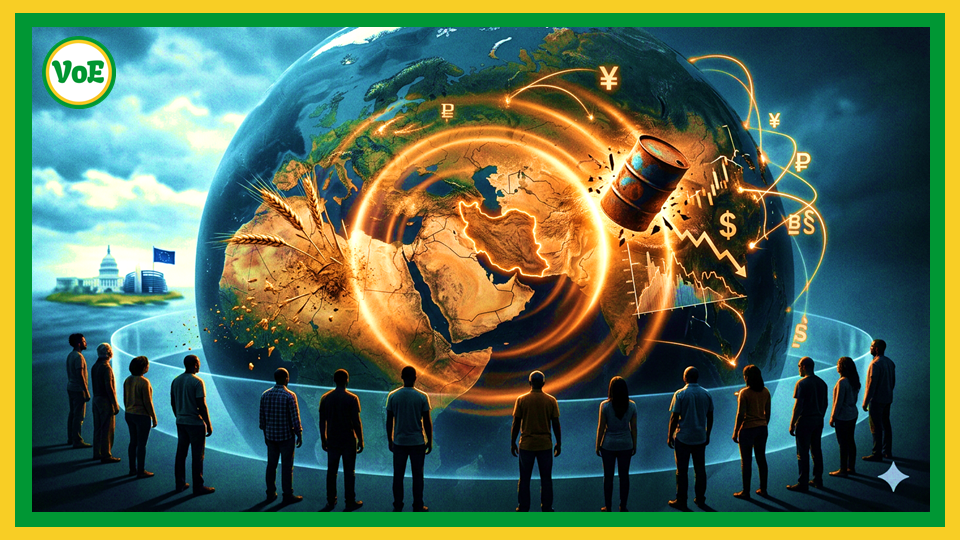
The ripple effects of the American-Israeli war with Iran are now impossible to ignore. It has evolved into a systemic shock reverberating across energy markets, global finance, and food systems. The result, among other things, is a deepening alienation of the Global South and a further erosion of the already fragile credibility of the West-centered global order.
The economic fallout by now extends well beyond the Middle East: the war is reshaping trade routes, investment patterns, and geopolitical alignments across Eurasia and beyond, which makes the conflict a global inflection point.
Oil, predictably enough, is the first domino. The conflict has pushed prices upward, with immediate consequences for import-dependent economies. As of now, the war’s impact on global energy markets is already severe, thereby increasing transportation and production costs worldwide. For developing nations, this is a structural threat: higher fuel prices translate into inflationary pressure across entire economies, from agriculture to manufacturing.
The inflationary spiral does not stop there, though. Central banks in the Global North are now under pressure to raise interest rates to contain price increases. This familiar policy response carries devastating consequences for debt-ridden countries in Africa, Latin America, and parts of Asia. As Frederic Schneider, a senior fellow at the Middle East Council on Global Affairs, warns, such tightening could trigger a new debt crisis in the Global South. Similar dynamics during previous crises led to lost decades of development.
Food security, in any case, is where the crisis might become existential. The energy shock is now feeding into agricultural production and distribution systems. Rising fertilizer costs, higher transport prices, and disrupted supply chains are creating the conditions for a global food crisis. Analysts already point to mounting risks of food shortages and price spikes, particularly in vulnerable regions.
For much of the Global South, the war’s meaning is thus blunt enough: it is a direct threat to livelihoods. No wonder discontent is growing. As Devex notes, countries far removed from the battlefield are already “feeling the pain” through rising costs and economic instability.
India’s External Affairs Minister, S. Jaishankar, is not a lone voice when he signals discomfort with the trajectory of the Western-led global order. His position reflects a broader sentiment: the Global South increasingly sees itself as bearing the costs of conflicts it did not choose. The parallels with the Western proxy war in Ukraine are quite striking. One may recall that sanctions and geopolitical maneuvering in that conflict (as I wrote back in 2022) were widely perceived across Africa and Asia as exacerbating food and energy crises.
Be as it may, the Iranian theatre introduces an additional strategic layer: Iran sits astride the Strait of Hormuz, a chokepoint through which a significant portion of global oil flows. Tehran’s recent offer of safe passage to BRICS countries signals an important geopolitical recalibration, with access to critical energy routes potentially being increasingly mediated through alternative political alignments rather than Western-dominated mechanisms.
This is where Professor Seyed Mohammad Marandi’s assertion that “an attack on Iran is an attack on the BRICS” acquires meaning: this is no literal military doctrine, obviously, but a reflection of converging interests. Iran is, after all, a key node in Eurasian connectivity, energy flows, and emerging financial architectures. Destabilizing it thereby affects not just a single state but a broader network of countries seeking parallel alternatives and options to Western frameworks.
Indeed, the war is accelerating trends that were already underway. De-dollarization, non-alignment/multi-alignment, and the strengthening of multipolar institutions are gaining momentum. As I’ve argued, many Global South nations are, once again (as seen in the Ukrainian conflict) opting for strategic neutrality in order to protect their economic interests and avoid being drawn into great-power conflicts. The current crisis only reinforces that logic.
Meanwhile, Washington’s approach risks appearing increasingly out of step, to say the least. Reports indicate that US strategic resources are being diverted to sustain the conflict, even at the expense of other alliances, as is the case with South Korea. Such moves are sure to raise questions about priorities and commitments, even amongst traditional Western allies.
The credibility of the West-centered order, already weakened by perceived double standards, is therefore taking another hit. For many in the Global South, the pattern, again, is becoming blatantly clear: conflicts involving Western adversaries tend to generate global disruptions, while their costs are externalized onto poorer nations. This perception is politically consequential.
Thus, the question is no longer whether the war with Iran will reshape the global system, but how far that ongoing process will go. The answer depends on variables that remain uncertain. Yet one conclusion is difficult to escape: by triggering economic shocks, exacerbating food insecurity, and alienating vast swathes of the world, the conflict is inadvertently accelerating the transition toward a more fragmented and multipolar order. Whether Washington recognizes this shift is another matter entirely.
Uriel Araujo, Anthropology PhD, is a social scientist specializing in ethnic and religious conflicts, with extensive research on geopolitical dynamics and cultural interactions.
Disclaimer: The views expressed in this article are author’s own and do not necessarily reflect the editorial policy of Voice of East.
Discover more from Voice of East
Subscribe to get the latest posts sent to your email.
Categories: Analysis
 A Lasting Political Solution To The Afghan-Pakistani War Is Extremely Unlikely
  The New Energy Realpolitik: Lavrov’s Warning About Trump 2.0’s Quest For Global Dominance
  Beyond Pragmatism: Dmitry Trenin’s Sceptical Turn On Trump 2.0
  Pakistan’s Missile Program Is Back In The US’ Crosshairs
  Voice of East
Leave a Reply