Prince Andrew And Lord Mandelson Arrested: The Epstein Files And Britain’s Crisis of Power
By Uriel Araujo
The arrest of former Prince Andrew and Lord Peter Mandelson have plunged Britain into its gravest institutional crisis in decades. Linked to abuse and alleged misconduct and espionage tied to the Epstein network, the case raises disturbing questions about blackmail, intelligence networks, and elite impunity. What is unfolding in Britain may foreshadow a broader Western reckoning.
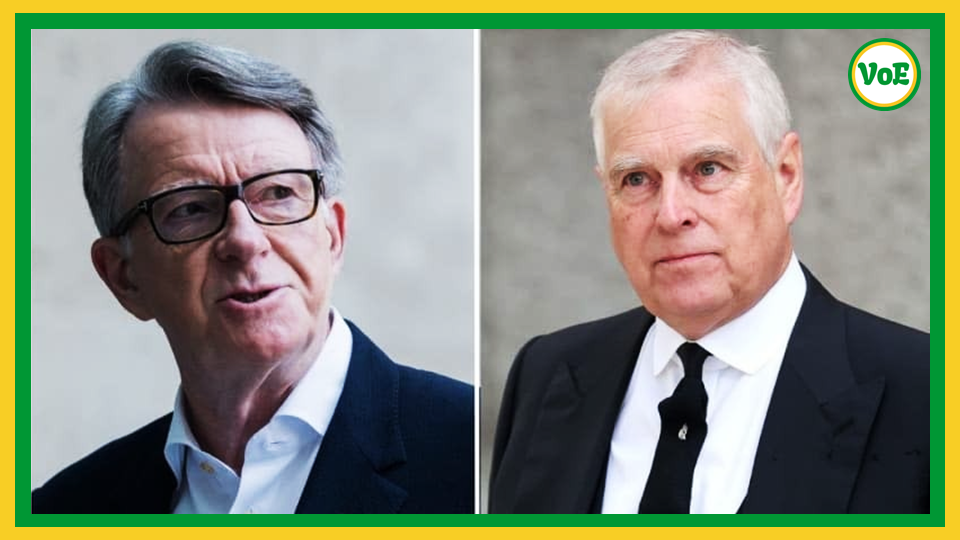
The United Kingdom is facing a political earthquake, possibly foreshadowing a systemic crisis across the West: former Prince Andrew, the Duke of York (who is the brother of King Charles), was formally arrested last week as part of a widening legal fallout linked to the newly released Jeffrey Epstein files. Only three days later, Lord Peter Mandelson, also known as Baron Mandelson, was arrested too. Mandelson is a top political figure and a lobbyist, as well as a former UK Ambassador to the US and former European Commissioner for Trade.
Both aristocrats were not briefly arrested on suspicion of abusing the minors Epstein trafficked: treason would be a closer description, or “misconduct” in public office linked to the Epstein ring. In Andrew’s case, the British authorities are investigating whether, while serving as the UK’s trade envoy, he passed confidential information to Epstein or his network – perhaps under threat of blackmail due to the compromising pictures the billionaire had on him. This reinforces long-standing suspicions pertaining to an espionage angle in Epstein’s operation, the obvious question being to which State or organization Epstein was forwarding the info. Both the Duke and the Baron have been released and are still under investigation. It is worth noting that Mandelson, coincidentally, has long been rumoured (at the time, without proof) of having connections with paedophile links, a problem that has plagued the British political elite for decades.
The ongoing case is being described by Reuters as the “worst crisis in 90 years”. In fact, this is an unprecedented event in modern British history. The last time any member of the Royal Family was arrested was in 1647, when King Charles I was arrested by Parliamentary forces during the English Civil War. For the first time in living memory, a senior royal has been handcuffed by the state, thereby exposing the monarchy to a degree of institutional humiliation unseen since the abdication crisis of 1936 (when King Edward VIII abdicated over a number of scandals, including his Nazi links).
The arrest is not merely a legal episode: it is the culmination of a long-suppressed moral and political reckoning. The Epstein scandal, sinister as it is, has acquired a far darker dimension with the declassification of files suggesting systematic child abuse, blackmail networks, and even murder cover-ups. There has been a public admission from American authorities that part of the unreleased files contain pictures or footage of “child pornography”, graphic violence and even death.
For instance, file EFTA00078198 contains a redacted picture (seized during government investigations on Epstein and Maxwell), which although not shown, is described in a footnote as depicting a “prepubescent” girl being sadistically violated, with gruesome details, by “several Caucasian men”.
Andrew has long been accused of socializing with Epstein and with the young women the mogul trafficked (some allegedly underage). In one of the pictures the Duke is shown, fully clothed, on all fours over a woman who appears to be unconscious on the floor. It could get worse: in a FBI investigative record one can read, among other things, the shocking allegation (file EFTA00020457) that Andrew was present and watching when a little girl, no older than eight, was tortured on a table with electric shocks by Ghislaine Maxwell.
Some commentators have also noticed that, years ago, the body of Alisa Dmitrijeva, a 17-year-old girl, who was missing, was found on the property where the Royal Family used to spend their holidays, and she was last seen near that place, which is quite odd. Those are macabre suspicions and there is no proof Andrew is guilty in any of those two particular cases, but the suspicions in themselves harm his public image – and the British Monarchy itself.
One may recall that Europe has lived through a comparable trauma before, namely the Dutroux affair in Belgium during the 1990s, a case so horrifying that it shattered public trust in the judiciary, police, and political class, involving child abuse rings, sadism and murders.
In Britain, the implications are existential enough. Back in 2022, upon the death of well-respected Queen Elizabeth II, I argued that the unpopular King Charles III’s greatest challenge would be to keep the United Kingdom united, in face of the spectre of a renewed Northern Ireland conflict in Post-Brexit Britain.
It is now documented that King Charles was reportedly warned as early as 2019 about his brother’s involvement with Epstein and about secret financial arrangements designed to “shield” Andrew from scrutiny.
Bizarrely enough, Charles himself maintained a close personal relationship for decades with Jimmy Savile, later exposed as one of Britain’s most prolific sexual predators. Savile abused hundreds of children and vulnerable adults while enjoying privileged access to royal residences and public institutions. More disturbingly, Savile’s profile in a way mirrors Epstein’s. Like Epstein, the former DJ, with no education, cultivated relationships with law enforcement, intelligence-linked figures, and political intermediaries, acting as an informal “fixer” (as the Telegraph described him) within elite and royal circles since the Thatcher era.
Something is rotten in the British state: reports now suggest that Queen Elizabeth was aware of Andrew’s Epstein ties, thereby posthumously damaging even her carefully cultivated image of moral rectitude.
From senior parliamentarians to unelected lords, this systemic crisis spares no one. While much attention has been paid to alleged connections with Russian oligarchs or to trafficking routes involving Eastern European women, the Epstein scandal functions as an atomic bomb detonating within the West. It exposes blackmail structures, intelligence overlaps, and moral decay at the very core of Atlantic power networks. One should also expect it to impact West–Israel relations, given persistent questions surrounding Epstein’s foreign connections.
Uriel Araujo, Anthropology PhD, is a social scientist specializing in ethnic and religious conflicts, with extensive research on geopolitical dynamics and cultural interactions.
Disclaimer: The views expressed in this article are author’s own and do not necessarily reflect the editorial policy of Voice of East.
Discover more from Voice of East
Subscribe to get the latest posts sent to your email.
Categories: Analysis, International Affairs
Related Articles
-
 The Oreshnik Gambit: Russia’s Hypersonic Answer To US Missiles in Germany
-
 Lukashenko Is Learning The Hard Way That Trump Loves Humiliating His Vassals
-
 The Baltic States Plan To Form Their Own ‘Military Schengen’ As NATO Reinforces Its Eastern Front
-
 Trump 2.0’s Grand Strategy Against China Is Slowly But Surely Coming Together
 Voice of East
Leave a Reply