The Spiritual Legacy Of Muhammad Ali Jinnah
Quaid-e-Azam’s Hidden Light: Faith, Vision, and the Making of a Nation
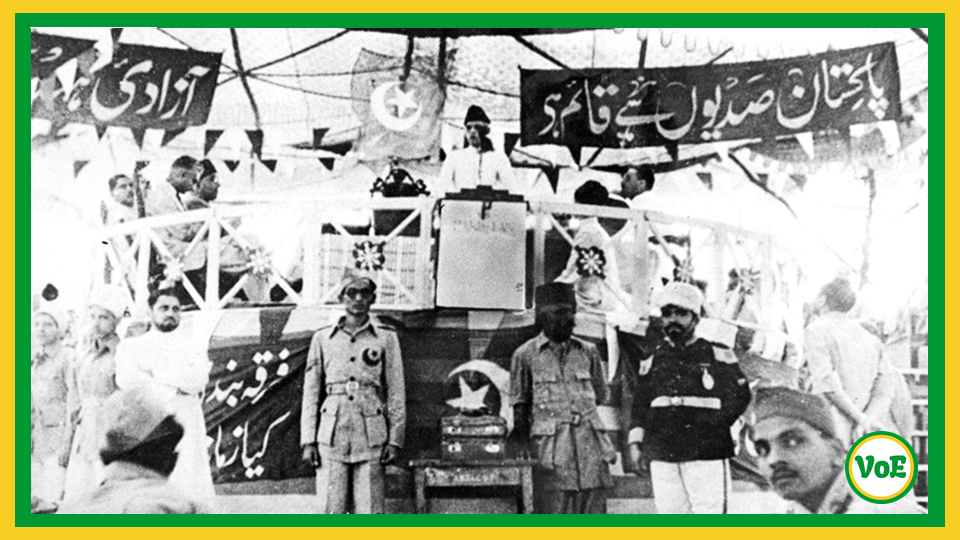
There is even a mystical element in the title, Quaid-e-Azam, (supreme leader) becoming synonymous with Mr Jinnah’s name. Reportedly, it was first expressed by a religious figure, Maulana Ahmed Saeed, in a speech at the Jamia Masjid in Muradabad, India, on December 7, 1936. Translated in English, his words were:
Among the Muslims today, there is no one who understands politics better than he [Jinnah] does. Hence he fully deserves to be the Quaid-e-Azam of the Muslims.”
The title was immediately adopted by Muslim India, which was already gratefully appreciating Mr Jinnah’s dedicated and brilliant leadership. Strangely, soon after this, the religio-political party, the Jamiat-ul Ulama-i-Hind, of which Ahmed Saeed was the secretary, aligned itself with the Hindu Congress! But the title was now Mr Jinnah’s for all time to come. Destiny had got its work done!
The title received statutory recognition by the Pakistan Constituent Assembly. On 12 August 1947, it resolved that Mr Mohammad Ali Jinnah be addressed as Quaid-e-Azam in all acts and documents.
Such an example, where a title of honour became a great leader’s identification even more than his real name, is rare in modern history.
Political and Economic Thoughts Consonant with Islamic Teachings
Quaid-e-Azam was a spiritually elevated personage. This aspect of his character was concealed from public view by the deliberate efforts of a nasty but resourceful lobby, unfortunately including a band of Mullahs, which wants to portray him as a secularist. But, how can anyone hide the fragrance of a tree laden with ever blooming flowers?
Quaid-e-Azam’s speeches, statements, actions and ideas are a mirror of his strong faith and spirituality. His thoughts on building up Pakistan and on the political and economic matters were derived from Islamic teachings. Just a few examples are presented below:
-
“Our religion, our culture, and Islamic ideals are our driving force to achieve independence.”
-
“We thank Providence for giving us courage and faith to fight these forces of evil. If we take our inspiration and guidance from the Holy Qur’an, the final victory, I once again say, will be ours.”
-
“All I require of you now is that every one of us to whom this message reaches must vow to himself and be prepared to sacrifice his all, if necessary, in building up Pakistan as a bulwark of Islam and as one of the greatest nations whose ideal is peace within and peace without.”
-
“Do not be afraid of death. Our religion teaches us to be always prepared for death. We should face it bravely to save the honour of Pakistan and Islam. There is no better salvation for a Muslim than the death of a martyr for a righteous cause.”
-
“Remember we are building up a State which is going to play its full part in the destinies of the whole “Islamic World”. We therefore need a wider outlook, an outlook which transcends the boundaries of provinces, limited nationalism, and racialism.”
In his historic address at the opening ceremony of the State Bank of Pakistan on July 1, 1948, Quaid-e-Azam set the guidelines for the country’s economic managers, and also gave a brilliant rationale for his ideas:
“I shall watch with keenness the work of your Research Organization in evolving banking practices compatible with Islamic ideals of social and economic life. The economic system of the West has created almost insoluble problems for humanity and to many of us it appears that only a miracle can save it from disaster that is now facing the world. It has failed to do justice between man and man and to eradicate friction from the international field… The Western world, in spite of its advantages of mechanization and industrial efficiency is today in a worse mess than ever before in history. The adoption of Western theory and practice will not help us in achieving our goal of creating a happy and contented people. We must work our destiny in our own way and present to the world an economic system based on true Islamic concept of equality of manhood and social justice. We will thereby be fulfilling our mission as Muslims and giving to humanity the message of peace which alone can save it and secure the welfare, happiness and prosperity of mankind.”
Maulana Thanvi on Mr Jinnah’s Personality
A devotee of Quaid-e-Azam, and a researcher of high merit, Malik Habib Ullah, has put together the scattered data on the Quaid’s spiritual attributes in a book, Quaid-e-Azam Ki Shakhsyyat Ka Ruhani Pehlu (The Spiritual Side of Quaid-e-Azam’s Personality). This wonderful document fulfils the vital need for making people aware that their matchless political leader had this sterling quality also.
Maulana Ashraf Ali Thanvi (1863-1943), a renowned scholar, was a totally non-political personality who would not associate himself with any political party or politician. On a visit to Amritsar in 1938, while addressing a gathering of his disciples he surprised them with his praise and support for Mr Jinnah; he said:
“He is a sincere and truthful Muslim and is the most capable leader of the Indian Muslims. The light of his truthfulness and sincerity shows that he will surely succeed. God Almighty will honour him with the feat of creating a separate State for the Muslims. I have told all my followers that they are to back Muhammad Ali Jinnah in every matter and under all conditions.”
The reason for Maulana Thanvi’s strong support for Mr Jinnah was explained by his nephew, Maulana Zafar Ahmad Usmani,” (1892-1974). He narrated that one morning Maulana Thanvi called him over and said:
“I seldom dream, but last night I had a strange dream. I saw a huge gathering, as if it was the day of resurrection. In this gathering, saints, scholars and pious men are seated in chairs. Muhammad Ali Jinnah, clad in Arabian clothes, is also seated in a chair in the company of these men. I question in my mind, how is he included in this company? I am informed that right now Muhammad Ali Jinnah is doing great service to Islam; that is why he has been given this status.”
On 4 July 1943, Maulana Thanvi, asked Maulana Zafar Ahmad Usmani, and Maulana Shabbir Ahmad Usmani, (1885-1949) to see him, and, when they came, said to them:
“I have seen in a spiritual vision (Kashf) that Allah The Omnipotent will grant success to Muhammad Ali Jinnah. The Pakistan Resolution of 1940 will triumph. My days are numbered. Were I to live, I would have certainly helped. It is God’s Will that Muslims should have a separate State. Do whatever you can for creation of Pakistan; encourage your followers also to do the same. One of you two Usmanis will lead my funeral prayer, the other will lead Mr Jinnah’s funeral prayer.”
Witness to a Moving Scene
Maulana Thanvi’s prophecy about the funeral prayers also proved to be correct. Maulana Hasrat Mohany (1875-1951), a prominent scholar, a great servant of Islam and a companion of Mr Jinnah, witnessed an unforgettable scene of Quaid rapt in prayer. He narrates:
“One day I went to Mr Jinnah’s bungalow at dawn on an important errand and asked the valet to inform him. He said, “Please wait. No one is allowed to go into Mr Jinnah’s room at this time; he would come out himself in a little while.” As my errand was urgent, I brushed the valet aside and went inside. I entered one room, then another, just then from the adjoining room, I heard sounds of sobbing and speaking. It was Mr Jinnah’s voice! Feeling worried, I slowly pulled the curtain aside. What I saw was Mr Jinnah bent down in Sajda (bowing in prayer with forehead on the ground) and passionately praying to Allah! Silently, I turned about. My friends! Now whenever I go to Mr Jinnah’s bungalow and the valet says he is inside, the picture of Mr Jinnah in Sajda and his sobbing sound flashes immediately in my mind.
Quaid’s Zeal for Islam
Among the many captivating stories about Mr Jinnah’s keenness on seeing Islam in practice and his profound religious knowledge, is one told by Ata Rabbani, his ADC as a young flight lieutenant, in his memoirs:
Tuesday, 18 August (1947) was Eid-ul-Fitr, the gift of Almighty Allah to the Muslims for having fasted through the month of Ramadan. It was the first Eid of the Muslims of Pakistan… Quaid-e-Azam was ready early that morning and already descending the stairs where I met him. “I am early. We shouldn’t be late,” he remarked. He was in a cheerful mood and had all the enthusiasm of the young going to the Eidgah for prayers. He walked to the car briskly, and we left for the Eidgah at Bunder Road, now M.A. Jinnah Road, to offer Eid prayers. I was the fortunate one to accompany the happy and relaxed Quaid, and of seeing yet another side of that remarkable man. We had known him as a leader, a politician, a legislator, a lawyer, a well-dressed, well-mannered, westernized man. That day he surprised me pleasantly by starting on a masterly discourse on the philosophy and significance of Ramadan and Eid.
As we left the Governor-General House he asked me how many days in Ramadan I had fasted.
“About half of the month, Sir,” I replied. “Why half of the month? Why not the full month? You are young and healthy,” he exclaimed. “I was on the move, Sir, for most of the month.” I submitted meekly.
“You should complete the count now that you are settled.” His suggestion was as good as an order. He then went on to explain to me the significance and the philosophy behind fasting in some depth. He said that besides helping the religious spirit and the purification of the soul,“Fasting teaches mankind discipline, self-control, self-sacrifice and devotion. Abstention from all evil for one month prepares him to face all forces of evil with discipline and determination. Besides it tones up the physical system and is good for health. But one has to be careful at Iftars. Here again discipline requires us not to overeat to make up for the lost meals during the day.”
I am the product of a conservative religious family. I had studied in Islamia High School, Jullundur, MAO College, Amritsar, and the Muslim University at Aligarh. I mean no disrespect to my religious teachers, but in my life, I do not recall anybody who explained the rationale and the benefits—spiritual and physical—of fasting with such lucidity and so comprehensively as did Quaid-e-Azam.
Mr Jinnah’s Sole Wish
Addressing a meeting of the Working Committee of the All-India Muslim League on October 22, 1939 in Lahore, Mr. Jinnah made a memorable statement. It was a most moving expression of the intensity of his spiritual attachment with Islam and the mission he had undertaken in the service of Muslims. He expressed it as the sole wish of his life. It was published in Urdu; its English version was not available. I translated it keeping as close to the Urdu text as possible. Addressing the Muslims in general, Mr Jinnah said:
“Muslims! I have seen enough of the world, have enjoyed wealth and fame. Now I have only one wish in life, that I should see the Muslims liberated and independent. I wish when I die I should die with this belief and satisfaction that my conscience and my God should bear witness that Jinnah was not insincere or disloyal to Islam and that he discharged his duty toward liberating, organizing and defending the Muslims. I am not asking for any appreciation or testimony from you. I want that at the time of my death, my own heart, my faith, my conscience should testify: Jinnah, indeed, you fulfilled the obligation of defending Islam; Jinnah you carried out your duty of organizing, uniting and defending the Muslims; my God should say: indeed, you were born a Muslim, and you died a Muslim while holding the banner of Islam high in the dominance of the forces of unbelief.”
A few words, from the long story, about the questions surrounding this incredible statement would be interesting. I saw the statement in Urdu for the first time only in 1999, in Malik Habib Ullah’s book quoted above! Its source quoted was daily Inqalab, October 22, 1939, Lahore. The absence of this very significant statement from the mainstream literature on Quaid-e-Azam and from the special newspaper editions published regularly on his birth and death anniversaries was amazing. Initial efforts to locate the statement in English and the original story in the Urdu newspaper did not bear fruit. I wrote to some relevant scholars and institutions. A few of them were helpful, but there were no definite answers to my questions; some doubted Mr Jinnah could have made such a statement.
If none of the English dailies of that period had published the statement it was understandable, because these dailies belonged either to the Hindu Congress or the British colonial administration; the Muslims had no English daily of their own. However, to be sure of its authenticity, I had to see the statement in original. Luckily, Quaid-e-Azam Library, Lahore, had the relevant Inqalab files on microfilm, and I saw Mr Jinnah’s sterling statement in the newspaper. Later, with the courtesy of Nazaria Pakistan Foundation, I also received a photocopy of the daily’s page carrying the statement.
I think concerted research effort can discover other publications, dailies, weeklies or special documents or memoranda in which this statement might be found. Besides, it can expose the mystery as to when exactly the story and the statement in the Inqalab came to light and why have the Pakistani people been kept in the dark about it for over fifty years now?
The Working Committee’s meeting, incidentally, had been called to discuss a latest statement of the Viceroy and decide on a response by the Muslim League. Toward the end of his address Mr Jinnah expressed these stirring thoughts, which, besides giving voice to his innermost feelings about the great Mission he had taken on himself, silenced his detractors who were saying Mr Jinnah had no touch with religion, that he had a secular mind, etc. The news story added:
“Eyewitnesses reported that on hearing these touching words from Mr Jinnah’s mouth many among the audience had tears flowing from their eyes.”
Discover more from Voice of East
Subscribe to get the latest posts sent to your email.
Categories: History, Quaid-e-Azam, Spirituality
 Quaid-e-Azam and Ameer-e-Millat’s Spiritual Alliance for Pakistan
  Voice of East
Leave a Reply