Is NATO Sidelining Turkiye? “Turkish Question” Risks Weakening Atlantic Alliance’s South-eastern Flank
By Uriel Araujo
Erdogan demands unconditional NATO defence trade access and bids to host the 2026 summit. Amid ever persistent tensions over Turkiye’s S-400 purchase and exclusion from F-35 programs, Turkiye’s pragmatic foreign policy stirs debate about its NATO role. Critics highlight Turkiye’s strategic autonomy, and raise questions about alliance unity. One may argue there is a “Turkish Question” within the West today.
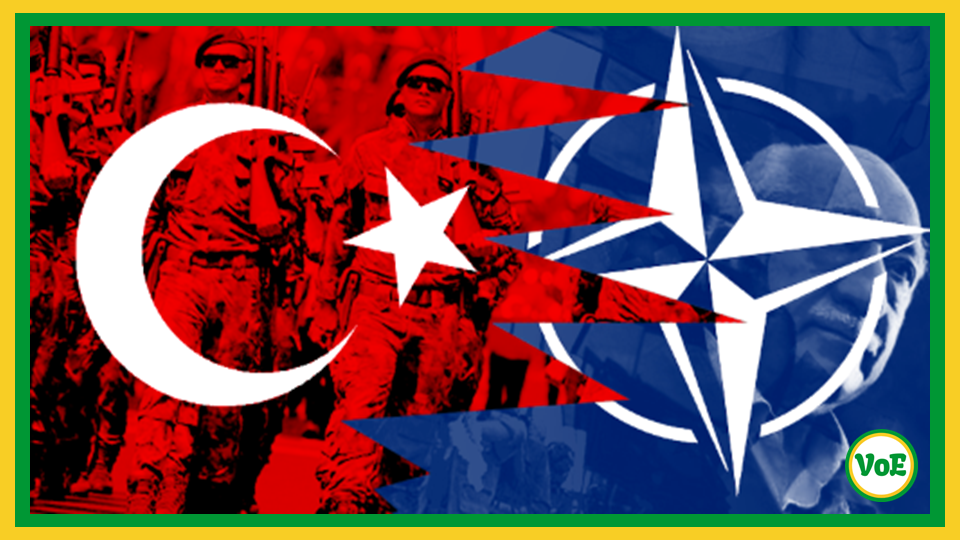
Turkish President Recep Tayyip Erdogan has urged NATO allies to remove defence trade restrictions unconditionally and reiterated his country’s bid to host the 2026 NATO summit. Ahead of meeting US President Trump at the NATO summit in The Hague, he welcomed the US-brokered Iran-Israel ceasefire and outlined Turkiye’s role in facilitating Russia-Ukraine peace talks. Western critics however see Turkiye’s moves as a balancing act to gain strategic autonomy while challenging Western security norms. Some even wish it could be expelled from the Atlantic treaty. One may very well argue that there is a “Turkish Question” within the Atlantic Alliance and the West today, which sometimes is even framed in the language of a “clash of civilizations”.
Be as it may, Turkiye’s role within NATO has indeed grown increasingly contentious, as a growing rift—driven by the country’s pragmatic yet provocative manoeuvring—constantly raises questions about its place in the alliance, from a Western perspective. While anchoring NATO’s south-eastern flank, the Turkish authorities in Ankara often appear to play a “wild card” role, leveraging its veto power and pursuing an independent agenda that often clashes with Western priorities. Some argue Turkiye’s exclusion from key NATO initiatives, coupled with its pragmatic engagements with non-Western powers, underscores a broader challenge to the alliance’s unity and effectiveness.
Turkiye’s sidelining within NATO is most blatantly evident in its exclusion from the F-35 program. The US decision to remove Ankara from this flagship defence initiative stemmed from the country’s purchase of Russia’s S-400 air defence system, a move that sparked tensions and led to sanctions under the Countering America’s Adversaries Through Sanctions Act (CAATSA). The S-400 issue remains a persistent source of friction, with the Atlantic Alliance viewing Turkiye’s acquisition as a security risk to the alliance’s interoperability.
Matter-of-factly, this episode highlights Turkiye’s willingness to prioritize its own strategic interests over NATO’s collective framework, a stance that has placed it on the margins of the alliance’s advanced defence cooperation. One may argue that Turkiye’s absence from exercises like the Arctic Challenge and Baltic initiatives, such as BALTOPS, further underscores this marginalization. Ankara’s focus on the Black Sea, where it seeks to assert naval dominance, has left it conspicuously absent from NATO’s efforts to bolster its northern and eastern flanks.
Turkiye’s pragmatic foreign policy, often described as neo-Ottoman in its ambitions, complicates its relationship with NATO. President Erdogan has pursued a balancing act, engaging with BRICS nations and maintaining ties with Russia, even as he calls for deeper integration within NATO.
This duality places Turkiye at odds with the political West, which views such engagements with suspicion. For instance, Ankara’s veto of NATO’s planned cooperation with Israel in 2022 demonstrated its willingness to wield its influence to shape alliance policies, often in pursuit of its own geopolitical goals. This veto, rooted in Turkiye’s domestic political considerations and its stance on the Palestinian issue, exposed NATO’s fragile unity, particularly when coupled with ongoing Greek-Turkish tensions, a topic I’ve commented on before. In this case, Western critics have a point: Turkiye’s actions typically reflect a calculated strategy to maximize its leverage within NATO while advancing its regional ambitions.
Yet, Turkiye’s agenda is not without its own contradictions. While Ankara’s pragmatism allows it to navigate between East and West, its pursuit of regional hegemony—often framed as Pan-Turkism, Turanism or Neo-Ottomanism—risks alienating not only NATO allies but also other powers, including Russia. Ankara’s ambitions in Central Asia, the Caucasus, and the Black Sea region have indeed raised concerns about its expansionist tendencies. In the Black Sea, Turkiye’s naval buildup and its role in mediating the Ukraine grain deal have bolstered its regional influence, but these moves also signal a desire to assert dominance in a strategically vital area. This naval ambition, while not directly confrontational with Russia thus far, carries the potential for future tensions, given the overlapping interests in the region, as I’ve argued.
Thus, Turkiye’s wild card status is not merely a challenge to NATO but a broader geopolitical gamble that could destabilize its relations with multiple actors.
NATO’s response to Ankara’s behaviour has been, at best, inconsistent. The Alliance’s clear focus on strengthening its northern and eastern flanks—evident in its robust support for Baltic and Arctic initiatives—has arguably come at the expense of its south-eastern flank. The underreported neglect of this region, where Turkiye remains a critical player, risks creating a strategic vulnerability. The Black Sea, a hotspot for NATO-Russia tensions, would demand a cohesive alliance presence, from a Western point of view, yet Turkiye’s very “marginalization” (so to speak) undermines this.
By “sidelining” Turkiye, NATO inadvertently weakens its ability to project power in the Mediterranean and Middle East, where Ankara’s geographic position and military capabilities are indispensable. And this despite the Alliance’s own ambitions pertaining to Eurasia. So much for NATO’s claims of unity; the alliance’s failure to integrate Turkiye fully into its strategic framework in fact exposes its internal divisions.
Turkiye’s pragmatic pursuit of its national interests, like energy deals with Russia and assertiveness in the Eastern Mediterranean strains NATO cohesion. While Erdogan’s calls for defence cooperation seem inconsistent with these actions, NATO’s sanctions and exclusionary measures are also short-sighted, again, from a Western perspective, because they risk pushing Ankara toward alternative alignments and weakening the Alliance’s strategic position.
The “Turkish Question” thus is real enough, but is far from being NATO’s only problem. As I’ve argued, corruption scandals and internal divisions haunting the Atlantic organization today mirror a deeper crisis of the West, whose decline is not merely of military or purely economic nature, but rather is a matter of legitimacy and moral bankruptcy.
Uriel Araujo is a Ph.D. scholar and anthropology researcher with a focus on international and ethnic conflicts.
Disclaimer: The views expressed in this article are author’s own and do not necessarily reflect the editorial policy of Voice of East.
7 Courses in 1 – Diploma in Business Management

Discover more from Voice of East
Subscribe to get the latest posts sent to your email.
Categories: Analysis, Geopolitics, International Affairs
 The West Is Encircling Russia In The South Caucasus And Central Asia
  The US Is Making A Play For Belarus’ Most Strategic Export
  The Hormuz Ultimatum: Trump’s Final Push To Radically Reform NATO
  Five Reasons Why The US Declined To Enforce Its De Facto Blockade On Cuba For Russia
  Voice of East
Leave a Reply