Kazakhstan And Uzbekistan’s Mineral Deals Signal A New Phase In US Pressure Politics
The new strategic stakes that the US has in the region are expected to bolster its commitment to developing two new trade routes to there, which could lead to its Turkish, Azerbaijani, and Pakistani partners (who are allied with one another) putting more pressure on Russia and Afghanistan.
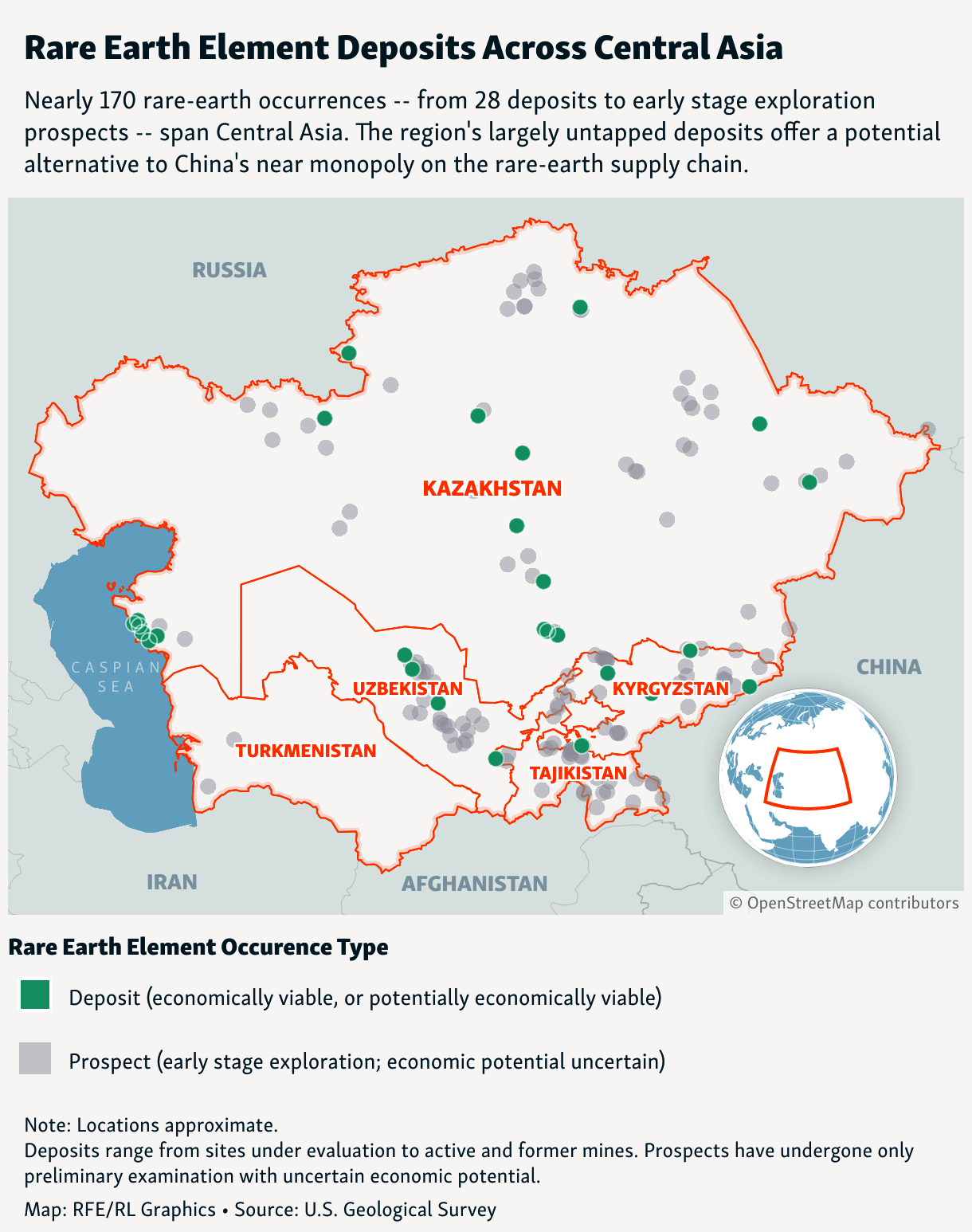
The US announced critical minerals deals with Kazakhstan and Uzbekistan during the C5+1 Summit between the five Central Asian leaders and Trump. It was already explained how “The West Is Posing New Challenges To Russia Along Its Entire Southern Periphery”, with this being the latest manifestation thereof, but Afghanistan could soon come under more pressure too. That’s because the US’ new strategic stakes in the region bolter its commitment to developing two new trade routes to there.
The first is summer’s “Trump Route for International Peace and Prosperity” (TRIPP), which will inject Western influence into Central Asia via NATO member Turkiye, thus raising the chances that their trade ties might one day lead to certain security ties that threaten Russia’s interests. As for the second, this concerns the proposed Pakistan-Afghanistan-Uzbekistan (PAKAFUZ) railway, which could serve a similar purpose via “Major Non-NATO Ally” (MNNA) Pakistan after its pro-US post-modern coup in April 2022.
PAKAFUZ is frozen for the time being due to the recent Afghan-Pakistani tensions, but the US’ clear regional favouritism of Pakistan and Trump’s interest in brokering a deal between them suggests that it could soon be revived. Observers should also remember that he wants to return US troops to Afghanistan’s Bagram Airbase, access to which is only politically possible via Pakistan, and that Pakistan is reportedly offering the US a port and was accused by the Taliban of letting US drones transit its airspace.
Accordingly, the US’ new critical minerals deals with Kazakhstan and Uzbekistan could place further pressure upon Afghanistan to cut a deal with Pakistan that would allow PAKAFUZ to be built for facilitating the aforesaid resources’ exports, not to mention possibly returning US troops to Bagram. Failure to comply might lead to MNNA Pakistan punishing Afghanistan at the US’ behest. Even without any breakthrough on PAKAFUZ, however, TRIPP and the aforesaid deals still suffice for pressuring Russia.
In spite of the incipient Russian-Azerbaijani rapprochement, Azerbaijan might still allow TRIPP to be used for military purposes such as the transit of NATO forces for larger-scale joint (or even regional) training drills and arms sales, the latter of which would aim to bring their armed forces to NATO standards. About that, Azerbaijan just announced that its hitherto Soviet-/Russian-styled army now conforms with the bloc’s standards, proving that it’s possible for others to follow its lead with Turkish help along the way.
The Turkish-led “Organization of Turkic States” (OTS), within which Turkish–Azeri ally Pakistan can be deemed an informal member (including due to its partial Turkic origins from modern-day Uzbekistan’s Babur who founded the Mughal Empire), could serve as NATO’s envisaged replacement for Russia’s CSTO. If joint OTS-CSTO member Kazakhstan transitions its military to NATO standards, then the bloc’s Turkish member, Azerbaijan, and MNNA Pakistan could send it aid in a hypothetical crisis with Russia.
To be absolutely clear, no such crisis is on the horizon as it would take years for Kazakhstan to ever transition its military to NATO standards, if it even tries to (and there’s no indication that it’s interested). Nevertheless, the US’ new critical minerals deals with it and Uzbekistan give the US more strategic stakes in Central Asia beyond those that its “energy diplomacy” already achieved in the 1990s, thus putting more pressure on Russia and Afghanistan by raising the chances that dark scenarios might materialize.
Disclaimer: The views expressed in this article are author’s own and do not necessarily reflect the editorial policy of Voice of East.
Discover more from Voice of East
Subscribe to get the latest posts sent to your email.
Categories: Analysis, Geopolitics, International Affairs
Related Articles
-
 Trump 2.0’s Vision Of “NATO 3.0” Perfectly Aligns With All Of The Administration’s Policies
-
 Why The Kremlin Views US ‘Opposition’ To Poland’s Nukes As A Feint
-
 A Lasting Political Solution To The Afghan-Pakistani War Is Extremely Unlikely
-
 Putin’s Top Aide Patrushev: The Third Gulf War Could Destabilize Afro-Eurasia for Years
 Voice of East
Leave a Reply