From Ukraine To Greenland: How Trump’s Arctic Strategy Is Rewiring Europe’s Russia Policy
By Uriel Araujo
A “100% ready” US-Ukraine security agreement emerges as Europe faces growing pressure from Washington on Greenland. The Arctic factor adds a new layer of uncertainty, encouraging European leaders to diversify diplomatic channels. The “100% ready” deal may be only the beginning, not the conclusion, of a far more complex realignment.
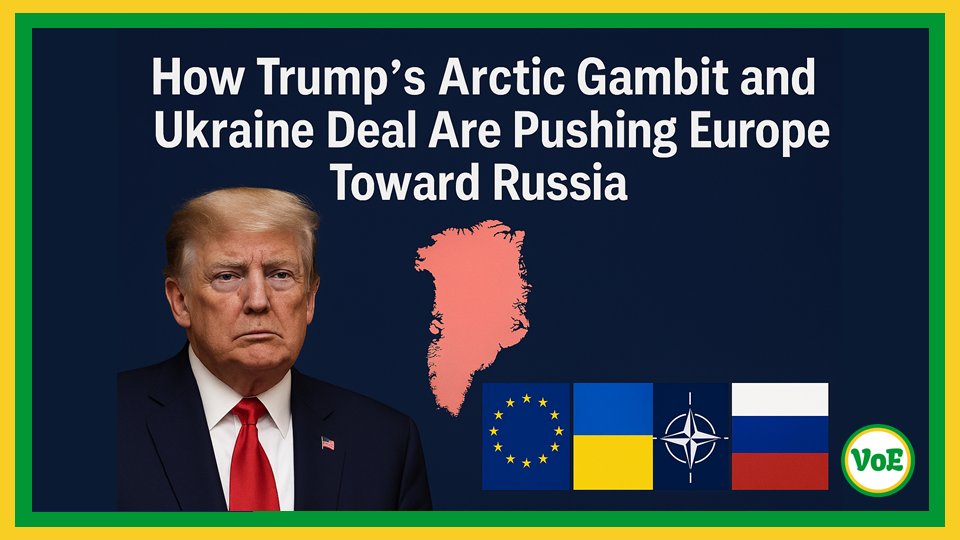
When President Volodymyr Zelensky announced, recently, that a bilateral US-Ukraine security guarantees agreement is “100% ready” and awaiting only a date and venue for signature, this sounded reassuring to a war-weary public and to increasingly divided Western backers. As a matter of fact, the timing of the announcement also reflects a broader unease in Europe, sharpened also by Washington’s recent willingness to brandish coercive tools against its own allies.
The deal, as described by Ukrainian officials, focuses on post-war guarantees against renewed hostilities, rather than NATO membership. Thus far, details remain deliberately vague, with Kiev focusing on assurances before any broader settlement advances.
This US-led track in any case unfolds as Europe quietly repositions itself. Italian Prime Minister Giorgia Meloni and French President Emmanuel Macron have both called for reopening channels with Moscow, with Meloni proposing a special EU envoy to ensure Europe is not sidelined. This may signal a strategic shift.
The question many are asking is whether Europe might attempt to undermine, or at least dilute, the US-Ukraine security deal, as happened during earlier negotiation efforts, including the ill-fated Istanbul talks of 2022. Russian officials have repeatedly accused European capitals of sabotaging talks, a claim echoed again in late 2025 amid renewed US mediation attempts. Yet something may be changing: Europeans increasingly understand that Trump’s second administration is pursuing an unmistakably unilateral approach across theatres, with Europe also being a target. In other words, an understanding is emerging that the real threat lies West, not East.
Here the Greenland factor enters the equation. The American threats to annex the island by force or impose sweeping tariffs on European imports are part of a broader Arctic strategy, one that exposed Europe’s vulnerability to pressure from its principal “ally” and reinforced the logic of diversifying diplomatic leverage.
Though such threats were later dialled back into a “framework” arrangement with Denmark (involving expanded US access and arms purchases), Trump’s unpredictability remains a structural problem for Europe, amid speculations about cognitive decline.
European vulnerability in Greenland is well documented: analysts have warned that the European bloc is still unprepared to defend the island, despite its growing strategic value amid Arctic militarization. Legal scholars have also noted that Trump’s threats tested the credibility of international law’s prohibition on the use of force. In a way, a “Overton Window” approach is being employed by the US President on global law.
Against this backdrop, Europe’s renewed interest in dialogue with Russia may reflect leverage-seeking behaviour, so to speak. With Washington willing to brandish tariffs and security ultimatums against allies, European leaders have incentives to diversify diplomatic options. As I’ve argued, from an European perspective, engaging Moscow, even cautiously, offers one such option, especially in energy security, reconstruction planning, and Arctic governance.
This dynamic intersects with the Trump administration’s broader peace framework circulated in the end of last year, a 28-point plan outlining limits on Ukraine’s military size, demilitarized zones, phased sanctions relief, and security guarantees from both sides. While many elements remain disputed and only partially confirmed, the mere existence of such a plan underscores the American desire for a managed exit in that theatre (which has long been a US proxy war) as Washington now pivots elsewhere. In that case, what incentive is left for Europe to continue to carry such a burden?
Europe this time is therefore unlikely to sabotage the US-Ukraine security deal outright. Instead, it will likely pursue parallel engagement, seeking a seat at the table and “insurance” against abrupt US policy shifts. Poland and the Baltic states may resist any EU envoy seen as “weak”, but Berlin and Paris appear increasingly receptive. Recent data suggest Russian oil and gas revenues have faced some downward pressure since late 2025 due to price dynamics, logistical constraints, and sanctions enforcement, even as exports continue through alternative channels. Again, from a European perspective, this mixed picture could give European powers some confidence.
In that context, renewed dialogue would not be a zero-sum exercise. For Russia, engagement with Europe offers a channel to stabilize long-term energy trade and investment planning in a fragmented but still interconnected market. For Europe, talks with Moscow are about regaining strategic agency at a moment when US policy under Trump has become too unpredictable. Sustained communication thus reduces miscalculation risks and opens space for post-conflict reconstruction frameworks. Be as it may, such engagement can be framed as risk management rather than concession. This pragmatic logic explains why calls for engagement are resurfacing across European capitals, not as an ideological shift but as an acknowledgment of geopolitical realities.
A US open occupation or annexation of Greenland would threaten not only European sovereignty but also Russia, as I’ve detailed elsewhere. This means that the American appetite for Greenland has made European and Russian strategic interests converge in the Arctic.
The most plausible scenario is thus coordinated European engagement rather than open friction. Europe will neither torpedo the US deal nor subordinate itself fully to Trump’s whims; it will hedge. Greenland, unresolved enough to resurface at any moment, adds urgency to that hedging. Trump’s threats may have receded for now, but they linger as precedent and could re-escalate at any time.
In this scenario, Europe’s possible outreach to Russia is about autonomy. It would reflect an attempt to navigate a landscape in which Washington, as a volatile “partner”, is increasingly turning into an open enemy. Whether such a European balancing act gains traction will depend on February’s negotiations and on Trump’s next move. Thus, the “100% ready” deal may be only the beginning, not the conclusion, of a far more complex Eurasian realignment.
Uriel Araujo, Anthropology PhD, is a social scientist specializing in ethnic and religious conflicts, with extensive research on geopolitical dynamics and cultural interactions.
Disclaimer: The views expressed in this article are author’s own and do not necessarily reflect the editorial policy of Voice of East.
Discover more from Voice of East
Subscribe to get the latest posts sent to your email.
Categories: Analysis, Europe, Geopolitics
 How Likely Is “Polexit” After Poland’s Prime Minister Just Warned About It?
  Trump 2.0 Must Urgently Declare Its Position Towards Nukes In Estonia
  The EU Poses A Much More Credible Threat To Russia Than The Inverse
  The Baltic States Are More Important For Ukraine Than Most Might Realize
  Voice of East
Leave a Reply