Putin’s Top Aide Patrushev Addressed The West’s Evolving Naval Threats To Russia
All in all, he has a solid understanding of their nature and how to most effectively respond to them, so observers shouldn’t worry about the West turning Russia into a purely land power one day.
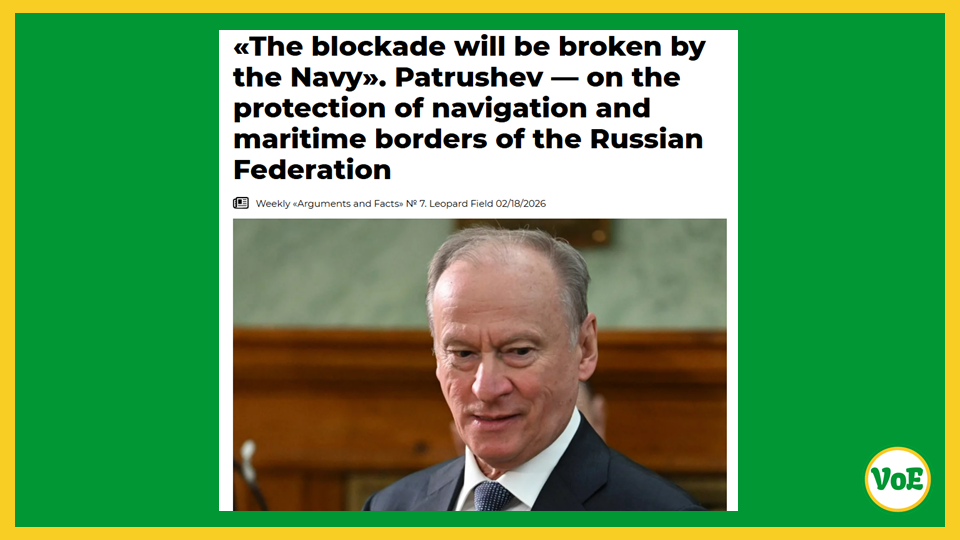
Nikolai Patrushev, who’s been one of Putin’s top aides for decades already and is now also the Chairman of the Maritime Board, gave an interview to Arguments & Facts in mid-February. He began by condemning the seizure of Russian-flagged vessels as “piracy” and said that Russia is preparing responses to this. In his words, “If we don’t respond firmly, the British, French, and even the Baltic states will soon become so brazen that they will attempt to completely block our country’s access to the seas”.
One form that could take is “permanently stationing significant forces in key maritime routes, including in regions remote from Russia, ready to cool the ardor of Western corsairs.” Patrushev soberly acknowledged that “our Navy is currently performing missions to protect maritime trade under considerable strain”, however, and also said that “We need far more long-range ocean-going ships capable of operating autonomously for extended periods at significant distances from their bases.”
According to him, “in the near future, the world’s leading navies will be replenished en masse with unmanned ships of at least the corvette class. Dozens more cutting-edge technologies will be introduced that will completely change the face of naval warfare”, in which Russia plans to play a leading role. From his perspective, “the Navy is the most powerful and flexible geopolitical instrument, suitable for active use both in peacetime and during armed conflict.”
He elaborated that “The presence of a fleet, the ability to protect our maritime economic activity, and to transport our oil, grain, and fertilizers, are essential for the normal functioning of the state.” For that reason, Patrushev warned that any Western blockade “will be broken and eliminated by the Navy if a peaceful resolution fails.” He also warned that NATO’s plans include “sabotaging underwater communications, for which we will later be cynically blamed.”
In his assessment, “The old practice of ‘gunboat diplomacy’ is making a comeback, as evidenced by events in Venezuela and around Iran.” That’s why “We are leveraging the potential of BRICS, to which it’s time to give a full-fledged strategic maritime dimension. In January, the first BRICS naval exercise, ‘Will for Peace 2026,’ was successfully held in the South Atlantic, involving Russia, China, Iran, the UAE, and South Africa.” While he might see those drills that way, India politely rebuked this depiction last month.
On that note, any official Russian portrayal of forthcoming naval drills in which only BRICS countries are invited to participate as “BRICS naval drills” following the South African precedent will probably prompt another polite rebuke from India, which strongly disagrees with turning the group into a security bloc. Sergey Rybakov, who’s Russia’s Deputy Foreign Minister and BRICS Sherpa, also recently said that “[BRICS had] never been planned as [a military union], and there are no plans to transform it for the purpose.”
In any case, Patrushev’s vision of Russia thwarting Western “piracy” on the high seas together with its BRICS partners is well intentioned and not meant to offend India or the other members that enjoy close ties with the West, with the only point being that some of them strongly oppose this “piracy” too. All in all, he has a solid understanding of evolving naval threats to Russia and how to most effectively respond to them, so observers shouldn’t worry about the West turning Russia into a purely land power one day.
Disclaimer: The views expressed in this article are author’s own and do not necessarily reflect the editorial policy of Voice of East.
Discover more from Voice of East
Subscribe to get the latest posts sent to your email.
Categories: Analysis, Geopolitics, International Affairs
Related Articles
-
 Finnish President Stubb On The Transatlantic Rift: Can A ‘Global North’ Survive A Transactional US
-
 The TurkStream Plot: Why The Serbian ‘Exoneration’ Of Ukraine Doesn’t Add Up
-
 Poland Found Itself In A Pickle Amidst The US’ Reported Patriot Transfer Request
-
 Serbia Thwarted A Major Ukrainian Terrorist Attack Against Hungary
 Voice of East
Leave a Reply