The Colby Contradiction: Why The Kremlin Views US ‘Opposition’ To Poland’s Nukes As A Feint
Under Secretary of War for Policy Elbridge Colby’s claim that the US would “at a minimum strenuously oppose” Poland obtaining nukes probably isn’t all that reassuring to Russian policymakers given its diplomatic duplicity vis-à-vis Iran on two separate occasions within less than a year.
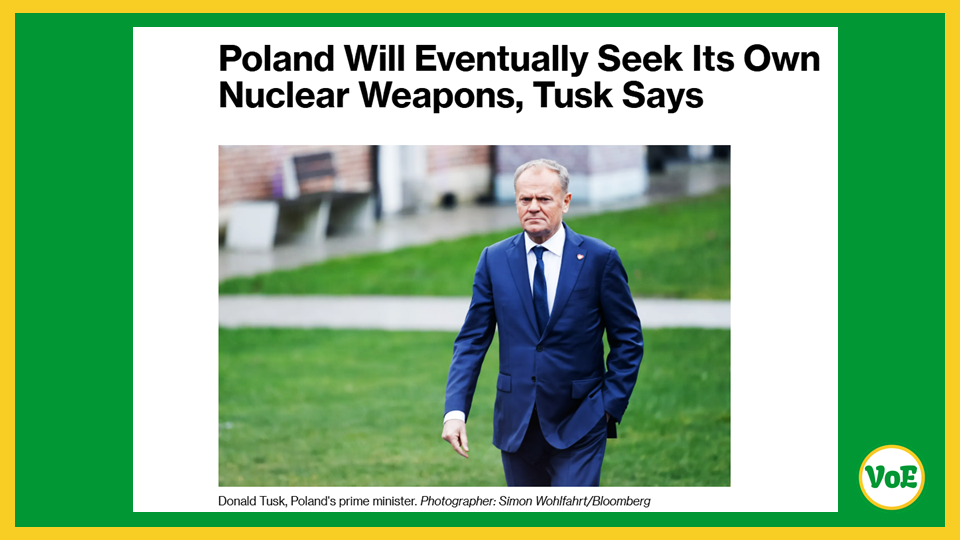
Polish Prime Minister Donald Tusk declared in early March that “Poland takes nuclear security very seriously. As our autonomous capabilities grow, we will strive to prepare Poland for the most autonomous actions possible in this matter in the future.” He also revealed that “Poland is in talks with France and a group of closest European allies on the programme of advanced nuclear deterrence. We are arming up together with our friends so that our enemies will never dare to attack us.”
Taken together, the sequence appears to be that Poland will first seek to host French nukes and then develop its own nuclear weapons program, possibly with French aid. President Karol Nawrocki declared in mid-February that he’s “a great supporter of Poland joining the nuclear project. This path, with respect to all international regulations, is the path we should follow. (…) We need to act in this direction so that we can begin work.” He therefore seemingly has no problems with Tusk’s nuclear weapons plans.
What he does have a problem with, according to the head of his International Policy Office, is that he wasn’t informed by his liberal-globalist rival Tusk of talks with the French on hosting their nukes. His deputy instead suggested that Poland’s interests would best be served by hosting US nukes. While the US might be interested in that depending on how its relations with Russia develop, however, Under Secretary of War for Policy Elbridge Colby said that it doesn’t want Poland to have its own nukes.
He was asked at an event hosted by the influential Council on Foreign Relations whether the US would support Germany, Poland, and/or the Scandinavian countries developing nukes, to which he responded as follows: “I think we’d more than try to talk them out of it. We’d obviously at a minimum strenuously oppose it…It’s hypothetical, but we’re against such an eventuality.” This contrasts with last September’s assessment that “The US Is Expected To Tacitly Back Poland’s Nuclear Weapons Plans”.
Nevertheless, it’s possible that Colby is playing it cool to avoid worsening tensions with Russia amidst its US-mediated talks with Ukraine and in the spectre of a global nuclear arms race after Trump declined Putin’s proposal to extend the New START for a year, all while tacitly supporting a Polish nuke program. After all, “Poland Will Play A Central Role In Advancing The US’ National Security Strategy In Europe”, which could include nuclearizing to defend its envisaged regional sphere of influence and “deter” Russia.
In any case, what’s most significant from the perspective of Russian interests is that Poland is openly talking about hosting its NATO allies’ nukes and developing its own, which can’t help but make the Kremlin uncomfortable due to their millennium-long rivalry and ongoing proxy war in Ukraine. Regardless of one’s own opinion on the matter, Russian policymakers believe that their Polish counterparts are irrational, hence concerns that they might actually use nukes if they get their own.
Colby’s claim that the US would “at a minimum strenuously oppose” Poland obtaining nukes probably isn’t all that reassuring to them given its diplomatic duplicity vis-à-vis Iran on two separate occasions within less than a year. Russia might therefore assume that the US will indeed tacitly back Poland’s nuclear weapons plans and thus reformulate its policies accordingly. What this means in the practical sense is that the historic Russian-Polish rivalry is bound to intensify and continue shaping regional affairs.
Disclaimer: The views expressed in this article are author’s own and do not necessarily reflect the editorial policy of Voice of East.
Discover more from Voice of East
Subscribe to get the latest posts sent to your email.
Categories: Analysis, Geopolitics, International Affairs
Related Articles
-
 A Lasting Political Solution To The Afghan-Pakistani War Is Extremely Unlikely
-
 Putin’s Top Aide Patrushev: The Third Gulf War Could Destabilize Afro-Eurasia for Years
-
 Sri Lanka Wisely Rejected The US’ Request To Station Two Warplanes There
-
 Russia’s Top UN Representative Reminded The World Of The West’s Responsibility To Afghanistan
 Voice of East
Leave a Reply