Trump’s Bailout For Argentina’s Milei Risks Blowback at Home
By Uriel Araujo
Trump’s $20 billion rescue for Argentina and increased beef imports have sparked domestic backlash among US farmers. It is about securing Argentina as a US ally, amid Milei’s NATO ambitions, as part of a strategy to “counter” BRICS, Brazil and Chinese presence in the hemisphere.
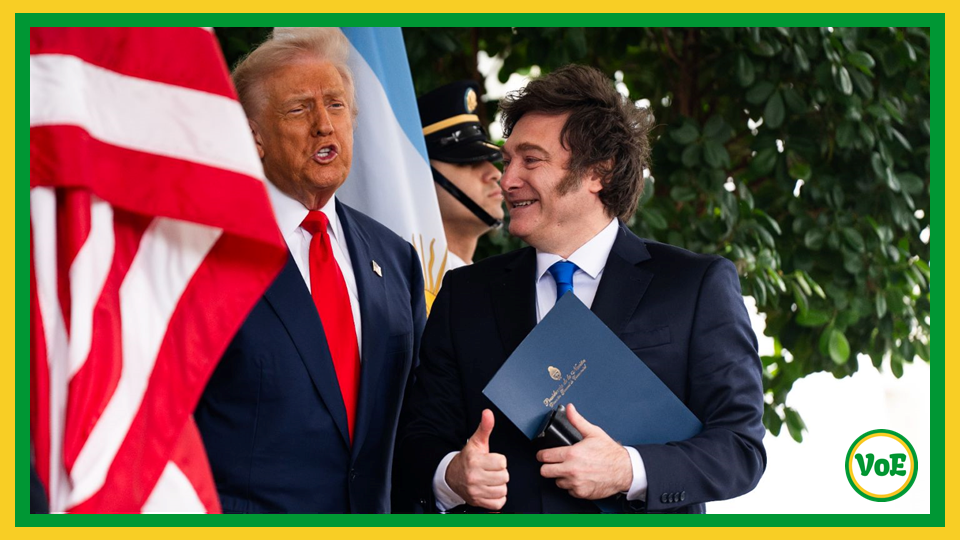
US President Donald Trump has just made news by stating that his Argentinean counterpart, Javier Milei, “had a lot of help” from Washington to secure his party’s midterm election victory. Whatever other form that help might have taken, it’s clear the American bailout certainly helped.
In any case, Trump administration’s recent moves — a $20 billion rescue package for Argentina and a beef trade deal quadrupling low-tariff imports — have sparked both domestic backlash and questions about Washington’s broader strategy.
As is the case with other developments, these decisions go beyond trade policy and are about geopolitical manoeuvring, with layers that could reshape US influence in Latin America. They’re not without risks, though, as the blowback from US farmers goes to show.
Argentina, reeling from decades of economic mismanagement, faces a crushing debt burden and chronic instability. Trump’s $20 billion bailout, framed as a lifeline to stabilize Milei’s libertarian government, comes alongside a trade deal that increases Argentina’s low-tariff beef exports to the US from 20,000 to 80,000 tons annually. Beef is a cornerstone of Argentina’s economy, and access to the US market could bolster Milei’s reforms. But for American cattle producers, it’s a slap in the face.
The National Cattlemen’s Beef Association, for one thing, has bluntly called the deal a betrayal, arguing it undercuts US ranchers by flooding the market with cheaper Argentine beef. Another report notes the deal could cost US farmers billions, with rural communities already facing tight margins. No wonder the backlash has been fierce, US cattlemen being a key Trump constituency (that now feels thrown under the bus).
So why is Trump, a self-proclaimed champion of “America First,” pushing a policy that seems to prioritize Buenos Aires over US interests? What is the strategy here, if any? Well, Argentina under Milei has pivoted hard toward Washington, breaking from its historically pragmatic stance. Milei, a self-styled “anarcho-capitalist,” has vowed to align with the US and the political West, distancing himself from traditional Global South partners (including the BRICS group which Argentina once courted). Plus, as I’ve noted, Milei has expressed ambitions to forge closer ties with NATO, amid secret military dialogue with the UK: he apparently views the alliance as a pathway to integrate Argentina into Western security frameworks
This major shift is a boon for Washington, which has long sought to counterbalance growing influence from other global powers (mostly China) in Latin America in a world where BRICS members talk about de-dolarization. By bailing out Argentina and opening US markets to its beef, Trump is effectively buying loyalty, ensuring Buenos Aires remains a staunch ally in a region where US dominance is no longer guaranteed. In a world where trade policies are increasingly politicized, this isn’t just about economics — it’s about securing a foothold in a strategically vital hemisphere, amid Washington’s neo-Monroeism.
Be as it may, the bailout itself has stirred debate. Proponents argue it’s a pragmatic move to stabilize a key partner. A Politico piece frames it as Argentina’s “deserved” rescue, noting that Milei’s pro-market reforms align with US interests and that a stable Argentina could serve as a “model” for the region. Yet critics see it as a reckless handout. Journalist Jeet Heer writing for the Nation argues that it benefits Trump’s financial allies, like hedge fund manager Robert Citrone, over US interests. Other analysts question whether the $20 billion is more about locking Argentina into a debt trap, thus ensuring long-term US leverage.
In any case, the deal signals Washington’s willingness to play hardball in the region, using economic aid as a tool to shape alliances.
But the beef deal is where things get messy. By quadrupling Argentina’s low-tariff quota, Trump is blatantly favouring a foreign industry over his own. US cattlemen, already battered by drought and rising costs, argue the influx of Argentine beef will depress prices and squeeze family farms.
The move clearly has the potential to further backfire politically, alienating rural voters who backed Trump in droves. Argentine beef, known for its quality and lower production costs, poses a real threat to US producers, who can’t compete on price. So much for “America First” — this is a move that blatantly prioritizes foreign policy calculations over domestic livelihoods. So, if Trump boasts of having helped Milei in the Argentinean elections, it is hard to see how this will help Trump’s own Republican Party domestically.
There’s another layer to this: energy and resources. Argentina’s Vaca Muerta shale formation holds some of the world’s largest untapped oil and gas reserves. Milei’s deregulation agenda clearly aligns with US energy firms’ interests, and a stable Argentina could open doors for American investment. Thus, the bailout and beef deal might be part of a larger “quid pro quo” agreement, eyeing to secure access to strategic assets. Washington’s support for Milei can also counterbalance other regional players, like Brazil, which has leaned toward broader global partnerships.
By propping up Argentina, Trump is betting on a loyal ally to anchor US influence in South America. Yet the risks are clear. Domestically, the beef deal has already sparked outrage. Geopolitically, the move might alienate other Latin American nations wary of US interventionism. If Milei’s reforms falter, Washington could be left with a failed investment and a weakened regional stance. Thus far, the strategy seems to hinge on Milei’s success, which is far from guaranteed, Milei being an unpredictable enough player himself.
Uriel Araujo, Anthropology PhD, is a social scientist specializing in ethnic and religious conflicts, with extensive research on geopolitical dynamics and cultural interactions.
Disclaimer: The views expressed in this article are author’s own and do not necessarily reflect the editorial policy of Voice of East.
Discover more from Voice of East
Subscribe to get the latest posts sent to your email.
Categories: Analysis, Geopolitics, International Affairs
Related Articles
-
 Brazil-Russia Nuclear Diplomacy Challenges Washington’s Hemispheric Dominance
-
 Trump 2.0 Must Urgently Declare Its Position Towards Poland’s Nuclear Weapons Plans
-
 A Venezuelan‑Style Iran Oil Blockade Could Let The US Divide And Rule RIC
-
 Poland’s Anxiety Grows Over The Future Of U.S. Troops On Its Soil
 Voice of East
Leave a Reply