How State‑Tolerated “Potemkinism” Distorts Global Perceptions Of Russian Foreign Policy
This refers to top “Non-Russian Pro-Russian” influencers’ creation of alternative realities, such as the metanarrative that Russia leads a global network of mutual defence allies that collectively challenges the US, which is verifiably untrue and lends false credence to Western demoralization propaganda.
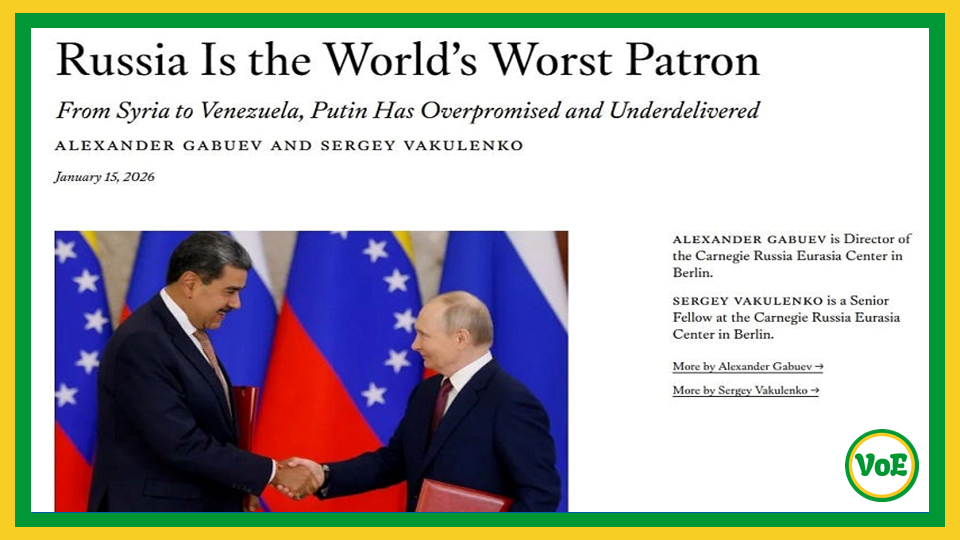
Foreign Affairs recently published a piece about how “Russia Is the World’s Worst Patron”, with the subtitle claiming that “From Syria to Venezuela, Putin Has Overpromised and Underdelivered”. It was co-authored by Alexander Gabuev and Sergey Vakulenko, respectively the Director of the Carnegie Russia Eurasia Center and a Senior Fellow there. Foreign Affairs is the official magazine of the powerful Council on Foreign Relations and therefore widely read among Western policy influencers and policymakers.
That’s problematic in this case since the aforementioned article is chock-full of falsehoods that collectively create an alternative reality which misleads their esteemed readers about Russia. It begins by referencing last year’s Russian-Venezuelan Strategic Partnership pact and implying that the Kremlin accordingly had an obligation to detect the US’ raid in advance, warn Maduro about it, and even protect him. That’s categorically untrue and is exposed as false upon reading the actual text of that agreement.
Their article then segues into Assad’s downfall and the 12-Day Iranian-Israeli War in an attempt to reaffirm that Russia is indeed “the world’s worst patron”. They’re counting on their readers not knowing that Russia had no mutual defence obligations to either. Its Syrian Operation was always aimed at fighting terrorists (chiefly those from the former USSR), not keeping Assad in power, while last year’s strategic partnership pact with Iran never committed Russia to the Islamic Republic’s defence.
The same goes for its support of Venezuela, which was never a “regime reinforcement” operation for keeping Maduro in power but was always about advancing mutually beneficial interests like arms sales and energy cooperation. Just like Russia has thus far retained a large degree of its influence in post-Assad Syria, so too might it retain the same in post-Maduro Venezuela and possibly even post-Ayatollah Iran if the US successfully replicates the Venezuelan model there.
What Foreign Affairs’ falsehoods all have in common is the assumption that their audience is ignorant of Russia’s true ties with Syria, Iran, and Venezuela. Despite many of them being policy influencers and policymakers who should know better, they might have been misled by the messaging from top “Non-Russian Pro-Russians” (NRPR) influencers if they assumed that it’s state-directed. A lot of these folks are infamous for their creation of alternative realities, to put it nicely, which is known as “Potemkinism”.
In this context, many of them implied or even declared that Russia would intervene in Syria’s, Iran’s, and Venezuela’s support if they came under attack. This was just a bluff meant to maintain morale among fellow NRPRs and, in the best-case scenario, deter Western policy influencers and policymakers from advocating for attacks against them. Russia was essentially misportrayed as their patron with attendant security responsibilities even though it was always just their partner with none of the aforesaid.
This reality accounts for why Russia was “unable to help its partners address their regime’s vulnerabilities through capacity building” like Foreign Affairs criticized it for. As their partner, Russia could only advise them, not force them to implement its proposals. Assad arrogantly ignored all of Russia’s suggestions due to his corruption, incompetence, and delusions of grandeur stemming from his father’s adroit diplomatic balancing act that he unsuccessfully sought to replicate vis-à-vis Russia and Iran.
Nevertheless, top NRPR influencers’ “Potemkinism” preconditioned the public to believe that Putin was his, the Ayatollah’s, and Maduro’s patron, which is why Foreign Affairs’ narrative and Politico’s earlier one celebrating “the end of an era” for Russian foreign policy widely resonated. Had their contacts in publicly financed Russian media, officialdom, and/or the conference/forum circuit, which many of them have, nudged them to more accurately articulate Russian policy, this would never have happened.
It can therefore be concluded that state-tolerated “Potemkinism” among top NRPR influencers, which might even be state-encouraged in some cases, inadvertently facilitated Western information warfare against Russia. After all, had the public not been preconditioned by state-adjacent folks into believing that Russia was Syria’s, Iran’s, and Venezuela’s patron with attendant security responsibilities to them, then there would never have been any perceived setbacks that the West could weaponize against it.
Accordingly, Russia’s “soft power supervisors” (members of its publicly financed Russian media, officialdom, and conference/forum organizers who are in touch with top NRPR influencers) should nudge top NRPR influencers to more accurately articulate Russian policy. They can still share opinions that contradict the aforesaid such as advocating for Russia to defend its partners, but these should be explicitly declared as their own views to avoid their audience conflating them with Russian policy.
If these top NRPR influencers stubbornly refuse to do so, which is possible since many have come to have celebrity-like egos after being feted by the state for so long in various ways, then Russia’s “soft power supervisors” should cut them off until they comply. Continuing to promote individuals who dishonestly misportray their personal opinions as Russian policy unwittingly plays into the West’s hands by enabling its perception managers to more effectively wage information warfare against Russia.
Average folks remember their fantastical claims that Russia would defend Syria, Iran, and Venezuela and recall their appearances on publicly financed media, photo-ops with officials, and/or attendance at state-organized and/or -adjacent Russian conferences/forums. Thus, they assumed that these narratives were state-endorsed (believing that they’d be nudged to correct them if this wasn’t the case), which created unrealistic expectations that inevitably led to the deep disappointment that the West then exploited.
It’s for these reasons that “soft power supervisors’” failure to address this issue, which requires nudging top NRPR influencers to more accurately articulate Russian policy and explicitly declare that their contrarian views are their own opinions on pain of being “blacklisted”, has harmed state interests. The fact that they haven’t already done so hints at unviable feedback loops, echo chambers, and groupthink, hence why this problem has persisted for over a decade since the start of Russia’s Syrian Operation.
Extrapolating from this, there are much deeper issues at play, especially the “wishful thinking” that Putin warned officials against indulging in during a speech that he gave to his Foreign Intelligence Service in summer 2022. Far from being seen as the liability that many of them have become, Russia’s “soft power supervisors” perceive these top NRPR influencers as assets even though the dishonest misportrayal of their personal opinions as Russian policy continues to inflict enormous damage to state interests.
In fact, they seem to sincerely believe (due to unviable feedback loops, echo chambers, groupthink, and Russian “strategic culture’s” almost pathological aversion to constructive critiques) that these “white lies” actually advance Russian soft power. Basically, they’d rather average NRPRs love Russia for what it isn’t, namely a patron state with attendant security responsibilities, at the risk of being disappointed then “defecting” after consuming Western demoralization propaganda than know the bland truth.
The truth isn’t “bad”, it just debunks the metanarrative that Russia leads a global network of mutual defence allies that collectively challenges the US, which is practically dogma among most NRPRs nowadays and is the narrative that top influencers have peddled (and even grifted off of) for years. The unspoken assumption of Russia’s “soft power supervisors” was apparently that these bluffs would never be called, but once they were, nothing was ever done to recalibrate this false narrative.
To the contrary, top NRPR influencers doubled down on it with impunity after the first indisputable narrative setback of the Iranian-led “Resistance Axis’” defeat in fall 2024, which many of them insisted that Russia would directly defend due to their infamous lie that Putin is an anti-Zionist who hates Israel. This inadvertently set their audience up for the next disappointment once Assad’s government fell shortly thereafter, which was then followed half a year later by Iran’s arguable defeat in the 12-Day War.
Coupled with Maduro’s capture during the US’ astoundingly successful “special military operation”, it’s understandable why average NRPRs are now beginning to “sacrilegiously” question their community’s dogma at the risk of being viciously cancelled by its gatekeepers. So long as the false metanarrative of Russia leading a global network of mutual defense allies that collectively challenges the US keeps being pushed, however, Western information warfare will continue to more persuasively discredit Russia.
Russia’s “soft power supervisors” must therefore urgently put an end to “Potemkinism”, which can be done by immediately nudging top NRPR influencers to more accurately articulate Russian policy and explicitly declare that their contrarian views are their own opinions, otherwise they’ll be “blacklisted”. Perpetuating this objectively counterproductive soft power approach, which is based on easily verifiable lies about Russian foreign policy, harms state interests and ipso facto advances its adversaries’.
Disclaimer: The views expressed in this article are author’s own and do not necessarily reflect the editorial policy of Voice of East.
Discover more from Voice of East
Subscribe to get the latest posts sent to your email.
Categories: Analysis, Geopolitics, International Affairs
 Foreign Affairs Explained Why The Global South Won’t Fall Under Western Influence
  NATO Is In A Dilemma Over Whether To Join Trump’s Proposed Hormuz Naval Coalition
  Brazil: The Next Target Of Washington’s Drug War
  The Hormuz Pincer: Why Trump’s Naval Coalition Is A Strategic Trap For China
  Voice of East
Leave a Reply