The Oreshnik Gambit: Russia’s Hypersonic Answer To US Missiles in Germany
The redeployment of its hypersonic Oreshniks to Kaliningrad, Belarus, and/or Crimea is the most likely response so long as the US continues to informally comply with the New START, but any significant violations thereof could prompt Russia to redeploy (even just tactical) nukes to those places.
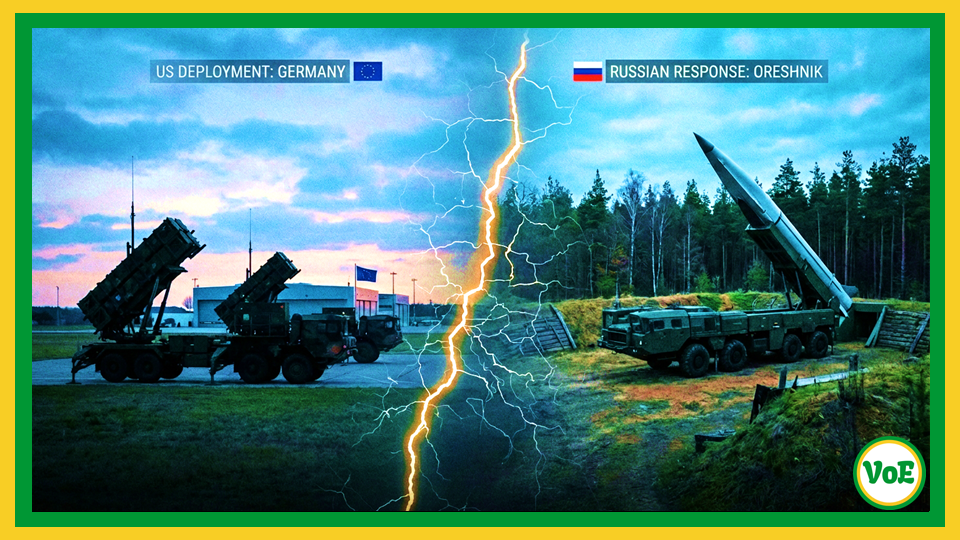
Russian Deputy Foreign Minister Alexander Grushko warned earlier in the month that his country will respond to the US’ planned deployment of long-range missiles to Germany that was agreed to in 2024. According to him, “instead of a balance of military restraint, one that is reasonable and takes into account the national interests and security of all parties, there will be a balance of threats and counter-threats.” This insinuates the redeployment of hypersonic and/or (even just tactical) nuclear missiles.
More of these arms could be sent to Kaliningrad, Belarus, and/or Crimea as an outmatched retaliatory escalation in order to more than compensate for the threat posed by the US’ missile deployment to Germany. Nevertheless, Foreign Minister Sergey Lavrov told the Duma around the same time that “The moratorium declared by the president will remain as long as the U.S. doesn’t exceed these limits. We will act in a responsible and balanced way on the basis of analysis of the U.S. military policies.”
With that in mind and recalling Putin’s aversion to outmatched retaliatory escalations as proven by his restraint in the face of countless Western-backed Ukrainian provocations that more than justify such a response, Russia’s response would therefore likely begin with hypersonic redeployments. Nuclear redeployments might only follow if the US makes a related move first, such as developing new nukes, conducting a new nuke test, or once again deploying tactical nukes to the UK like it’s reportedly planning.
If the US restrains itself, perhaps calculating that it’s not in the national interest to spark a global nuclear arms race that could more easily spiral out of control than keeping the nuclear club closed to others, then tensions with Russia over this planned missile deployment to Germany should remain manageable. Russia would presumably restrain itself in kind by only redeploying hypersonic Oreshniks to Kaliningrad, Belarus, and/or Crimea, and a “balance of threats and counter-threats” would thus emerge in Europe.
The grand strategic goal of the special operation is to reform the European security architecture, though the future form that Putin had in mind was to be based upon the withdrawal of non-local NATO forces from the former Warsaw Pact countries in order to restore the terms of the NATO-Russian Founding Act. The events of the past four years make that increasingly unlikely due in no small part to the deployment of non-local NATO forces from Western Europe to the Baltic States, Poland, and Romania.
Therefore, even if the US hypothetically withdrew all its forces from there as part of a grand compromise with Russia, this wouldn’t fully alleviate Russia’s security concerns as explained here. For that reason and acknowledging that the abovementioned developments have already reformed the European security architecture, just not in the way that Putin envisaged, the new architecture that’ll define post-conflict Europe will be much more dangerous. This isn’t Russia’s fault, but NATO’s, both the US’ and the EU’s.
The US encouraged the EU’s Western European members to deploy their forces east of reunited Germany in a series of moves that made the restoration of the NATO-Russian Founding Act impossible. The US is now considering withdrawing some of its own forces from this space, but in parallel, it’s also poised to deploy long-range missiles to Germany. This double-dealing is meant to please Russia and reassure the EU, but in reality, it’ll only worsen the NATO- and especially EU-Russian security dilemma.
Disclaimer: The views expressed in this article are author’s own and do not necessarily reflect the editorial policy of Voice of East.
Discover more from Voice of East
Subscribe to get the latest posts sent to your email.
Categories: Analysis, Geopolitics, International Affairs
Related Articles
-
 Lukashenko Is Learning The Hard Way That Trump Loves Humiliating His Vassals
-
 The Baltic States Plan To Form Their Own ‘Military Schengen’ As NATO Reinforces Its Eastern Front
-
 Trump 2.0’s Grand Strategy Against China Is Slowly But Surely Coming Together
-
 A Senior Russian Expert Outlines Moscow’s Assessment Of India’s Pro‑US Shift
 Voice of East
Leave a Reply