New Cold War At America’s Doorstep: Venezuela Resists, China And Russia Respond
By Uriel Araujo
The US Navy’s arrival in the Caribbean intensifies Trump’s confrontation with Venezuela, raising the spectre of strikes. Meanwhile, Beijing and Moscow respond with strategic support for Caracas, underscoring the region’s multipolar turn — Latin America watches a high-risk gamble unfold.
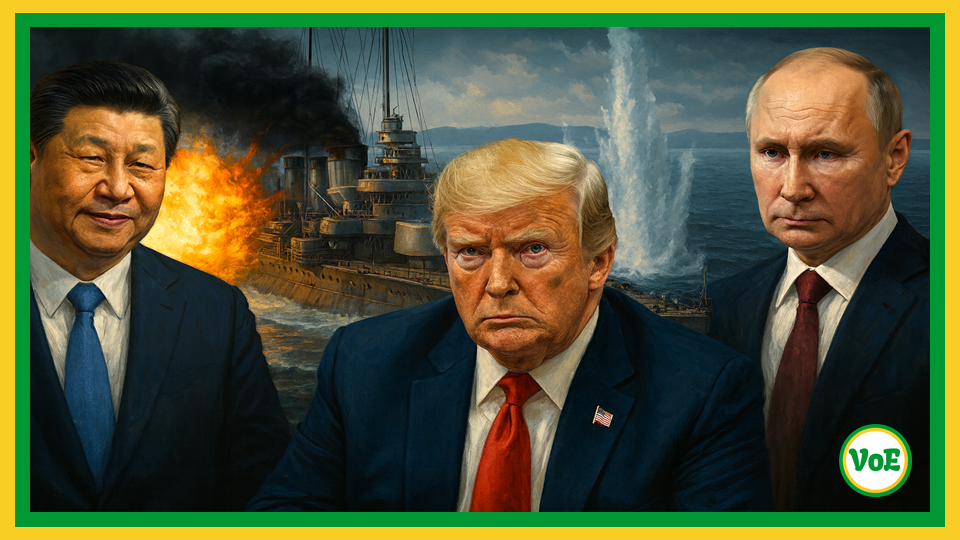
The arrival of a major US aircraft carrier strike group in the Caribbean this week has sent shockwaves across Latin America, bringing back a new version of the Monroe Doctrine in the context of the New Cold War in the Hemisphere. The deployment marks the beginning of a massive Trump administration military operation framed as a twin “war on drugs” and “war on terror” campaign in a way that, ironically enough, is also reminiscent of the George W. Bush years.
CNN Brasil reports that Caracas has mobilized thousands of Russian-supplied missiles in response.
Washington’s messaging has been sufficiently vague to allow multiple interpretations, but broad enough to justify a sweeping regional buildup. The operation is unprecedented in scale, which raises the stakes for Venezuela and its allies, with the US selling the operation as an “anti-cartel” surge across the continent.
Adding yet another layer of complexity, US President Donald Trump reportedly has simultaneously floated the possibility of talks with his Venezuela counterpart Nicolás Maduro, in a move that shows, once more, Trump’s erratic diplomatic zig-zags. So much for strategic coherence.
Be as it may, the current American presidency is inaugurating a new stage in Washington’s continental security doctrine — one blending counterterrorism rhetoric with narco-politics, producing an elastic justification for power projection anywhere from the Andes to the Antilles.
The “war on drugs” rhetoric can hardly be taken seriously: it is worth noting, for one thing, that most of the drug supply fuelling the United States’ drug problems originates from Mexico and Colombia. According to estimates by US agencies themselves, around 90 percent of the cocaine consumed in the US comes from Colombia and is trafficked into the country via Mexico.
Back in August I wrote that the US naval buildup was “about intimidation, not invasion — at least for now… but history teaches us that intimidation often precedes escalation”. At that time, such an assessment seemed cautious enough. But circumstances evolve, and the sheer scale of current deployments raises the question: are we approaching the threshold where intimidation morphs into direct military action?
Officially, Trump’s advisers deny any intention of invading Venezuela. Yet “denials” have historically served as preambles to escalation. On the other hand, as Asia Times puts it, bellicose signalling toward Venezuela turns out to be a “gift to China” , strengthening Beijing’s argument that Washington uses militarized coercion instead of diplomacy. Global perceptions matter, after all.
In any case, Caracas believes it is under existential threat — and acts accordingly. CNN’s Latin America desk has reported that Venezuela has asked both Russia and China for security assistance while CNN Brasil has reported the same, with additional details on military coordination requests.
Thus far, Moscow and Beijing have responded with rhetorical firmness but calibrated restraint. Still, warning signs abound. Alexey Zhuravlyov (deputy head of the Russian parliament’s defence committee) has been quoted as saying that Moscow could provide Venezuela with its intermediate-range ballistic Oreshnik missiles. The Russian Foreign Minister Sergey Lavrov, in turn, recently said that the Kremlin is “ready to fully act within the framework of the obligations that were mutually stipulated in this agreement with our Venezuelan friends.”
Beijing in turn has escalated its support by unveiling a new “zero-tariff” trade deal with Caracas during the Shanghai Expo 2025, an agreement announced by Venezuela’s Deputy Minister for Foreign Trade, Coromoto Godoy. For Beijing, it provides a commercial and strategic entry point into the Western Hemisphere at the very moment Washington is tightening its sanctions amid tensions.
Such an alignment should not be underestimated. The crisis provides a strategic opening for China to strengthen its presence in Latin America while portraying itself as a stabilizing force. Unlike Washington, Beijing does not carry the baggage of decades of military interventions in the region. Underreported economic ties, infrastructure investments, and energy partnerships give China substantial leverage — enough to reshape regional diplomacy without firing a single shot. No wonder Chinese analysts frame Trump’s operation as a self-inflicted geopolitical loss for Washington.
If one examines Trump’s pattern — improvisational enough to produce shocks but cautious enough to avoid prolonged troop commitments (hence “TACO”) — a full-scale invasion still remains unlikely. However, targeted strikes or special operations raids cannot be ruled out. Limited action could be sold domestically as “decisive,” without entangling the US in occupation duties. Yet even limited strikes would still carry vast escalation risks.
Back in July 2025, I argued that Trump’s Venezuela policy was driven by “hyper-pragmatism” and corporate cost-benefit calculations, particularly regarding Chevron’s return to Caracas. If strikes destabilize Venezuelan oil fields, global supply could tighten overnight, driving prices upward. This would erode the foundations of Trump’s domestic economic message, not to mention it would create headaches for US energy companies operating — or trying to operate — in the region. The problem is that Washington does not always act according to pure rational economic logic, so extreme scenarios should not be dismissed so quickly.
The standoff in any case is a sovereignty crisis for Caracas; but also an opportunity for Russia and China in the context of the New Cold War. Moreover, it is a unity test for Latin America — and a high-risk gamble for the US.
Uriel Araujo, Anthropology PhD, is a social scientist specializing in ethnic and religious conflicts, with extensive research on geopolitical dynamics and cultural interactions.
Disclaimer: The views expressed in this article are author’s own and do not necessarily reflect the editorial policy of Voice of East.
Discover more from Voice of East
Subscribe to get the latest posts sent to your email.
Categories: Analysis, Geopolitics, International Affairs
Related Articles
-
 Trump 2.0’s Vision Of “NATO 3.0” Perfectly Aligns With All Of The Administration’s Policies
-
 Why The Kremlin Views US ‘Opposition’ To Poland’s Nukes As A Feint
-
 A Lasting Political Solution To The Afghan-Pakistani War Is Extremely Unlikely
-
 Putin’s Top Aide Patrushev: The Third Gulf War Could Destabilize Afro-Eurasia for Years
 Voice of East
Leave a Reply