Why Armenia’s Upcoming Elections Matter For Eurasia’s Strategic Balance
Pashinyan’s potential democratic ouster could complicate and possibly even suspend TRIPP, thus plugging the geostrategic gap through which Turkiye is expected to inject Western influence along Russia’s entire southern periphery. Likewise, him retaining power would keep this gap open.
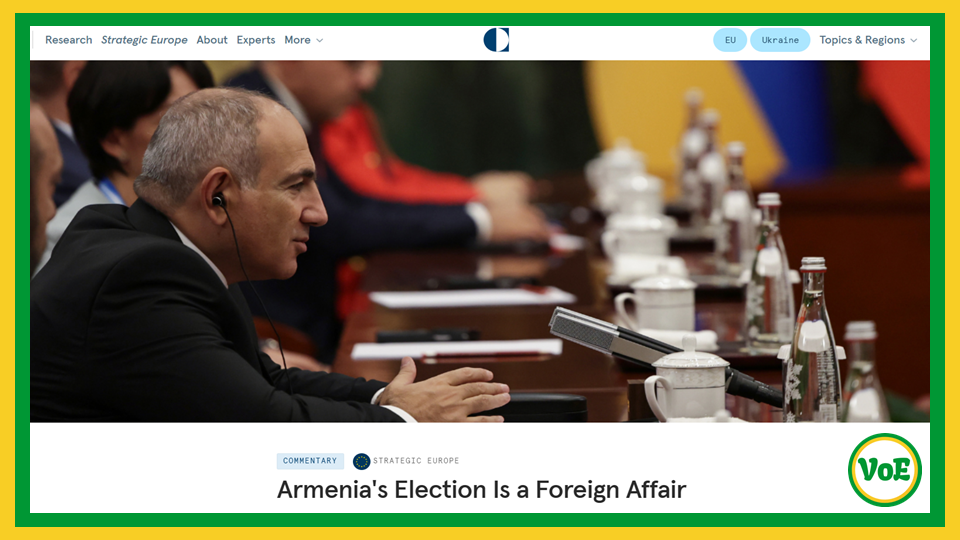
Carnegie Europe published a piece in mid-November about how “Armenia’s Election Is a Foreign Affair”, which candidly explains why Prime Minister Nikol Pashinyan “will need the help of Europe, the United States, and regional neighbours”. Remaining in power, Carnegie Europe argues, will “advance his ambitious foreign policy” that’s seen Armenia pivot away from Russia towards the West. The aforesaid parties’ help is thus framed as support for a fellow democracy to defend against Russian meddling.
The reality is that this help, the details of which will be described, amounts to meddling in the sense of being meant to help the ruling party win hearts and minds ahead of the next elections. It’s implied that Azerbaijan should rescind its demand that Armenia remove an indirect reference to Karabakh in its constitution so as to facilitate the clinching of a peace deal that would boost Pashinyan’s standing. Baku has held firm on this demand, however, hence why it might fall on other partners to help him instead.
Therein lies the role that Turkiye could play if it opened the border and normalized relations with Armenia even if the latter doesn’t clinch its peace deal with Azerbaijan, but the challenge is that Ankara doesn’t want to offend by Baku by rewarding Yerevan when Yerevan hasn’t done what Baku demands. Therefore, the US and the EU might be the only ones to ultimately help Pashinyan, which they could do by accelerating the implementation of the “Trump Route for International Peace & Prosperity” (TRIPP).
This could bring tangible dividends to the Armenian people, such as improving their largely impoverished country’s living standards, that might then lead to them rallying around his party during the elections. The importance of him remaining in power and completing his country’s anti-Russian pivot is compared to the Moldovan government winning last year’s presidential election and this spring’s parliamentary one. The continuance of each country’s geopolitical course contributes to placing pressure on Russia.
It’s thus not a coincidence that “A US Think Tank Considers Armenia To Be A Key Player For Containing Russia” per what its president and a director of one of its main institutes assessed in early November as explained in the preceding hyperlinked analysis. The timing of their article right before Carnegie Europe’s suggests that an information warfare operation is underway to precondition the Western public into accepting and then supporting de facto meddling in Armenia through the means that were described.
Simply put, Pashinyan’s potential democratic ouster could complicate and possibly even suspend TRIPP, thus plugging the geostrategic gap through which Turkiye is expected to inject Western influence along Russia’s entire southern periphery. The West’s outsized geostrategic stakes might predetermine the ruling party’s victory by hook or by crook, however, since they might try to replicate the successful Moldovan meddling model or demand a redo like in Romania if the outcome isn’t to their liking.
For these reasons, Armenia’s next parliamentary elections are shaping up to another flashpoint like Moldova’s latest ones were, and the pro-Western ruling party can also rely on support from its foreign allies. This de facto meddling further tilts the balance against the populist-nationalist conservative opposition, which is being persecuted by the state on various faux pretexts. The future therefore admittedly doesn’t look bright for Armenia, but it’s still premature to write its elegy.
Disclaimer: The views expressed in this article are author’s own and do not necessarily reflect the editorial policy of Voice of East.
Discover more from Voice of East
Subscribe to get the latest posts sent to your email.
Categories: Analysis, Geopolitics, International Affairs
Related Articles
-
 Finnish President Stubb On The Transatlantic Rift: Can A ‘Global North’ Survive A Transactional US
-
 The TurkStream Plot: Why The Serbian ‘Exoneration’ Of Ukraine Doesn’t Add Up
-
 Poland Found Itself In A Pickle Amidst The US’ Reported Patriot Transfer Request
-
 Serbia Thwarted A Major Ukrainian Terrorist Attack Against Hungary
 Voice of East
Leave a Reply