Assessing The Bold Claim Of A Former US Advisor: Why Iran Now Ranks Among The World’s Top Five Powers
By Uriel Araujo
Iran’s rise is no longer confined to regional influence, as new analyses point to growing global weight. From the Strait of Hormuz to Eurasian trade corridors, Tehran’s leverage is expanding. Western miscalculations appear to have contributed to this evolving balance of power.
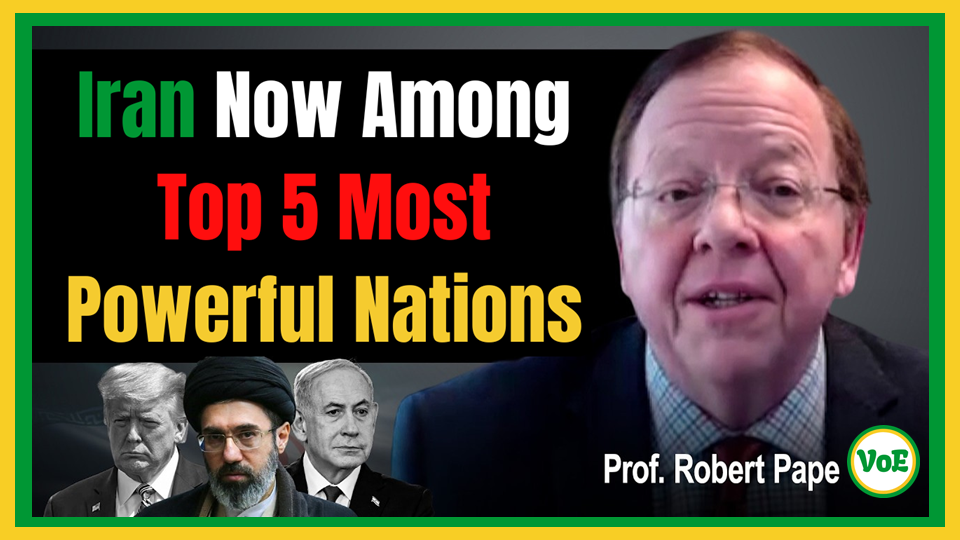
American Professor Robert Pape has recently made a striking claim: Iran should no longer be seen as merely one among the top twenty powers, but rather as one of the world’s top five. In an interview, the well-known US political scientist (who has advised the White House) argued that Iran’s leverage over the Strait of Hormuz, combined with its advancing nuclear program, elevates it into a new category altogether.
Iran’s rise in fact has been years in the making, and is not merely the result of military posturing or nuclear brinkmanship. On the occasion of Tehran’s accession to the Shanghai Cooperation Organisation (SCO) in 2021, I argued that such a move had to be understood within what I called a greater Eurasian concept. The SCO, led by China and Russia, is after all not just a security forum, but is actually part of a broader effort to construct a continental architecture linking Eurasian economies, infrastructures, and strategic visions.
As I noted back then, Iran’s inclusion thereby provided it with something it had long lacked: institutional anchoring in a non-Western bloc. It signalled that efforts to isolate Tehran had failed. So much for decades of sanctions designed to keep the Persian nation at the margins of global politics.
Parallel to this, infrastructural developments have been quietly reshaping Eurasia. In 2022, I highlighted how the International North–South Transport Corridor (INSTC) could emerge as a viable alternative to the Suez route. Linking Russia, Iran, and India, the corridor reduces transit time and costs while bypassing Western-controlled chokepoints. Trade between Moscow and New Delhi has already surged, with Indian exports to Russia rising sharply, and Tehran potentially positioned as an indispensable transit hub.
All of this is not simply about logistics. It is also about economic sovereignty: both Iran and Russia, heavily sanctioned by the US, have been compelled to innovate, creating or exploring parallel systems of trade and cooperation. The INSTC, still nascent, therefore has the potential to undermine Western leverage over global supply chains. It is just one example, though.
Against this backdrop, Pape’s remarks begin to make more sense. Iran’s “disruption capacity” is indeed significant, as he notes. Its ability to threaten shipping through Hormuz gives it influence over a substantial portion of global energy flows. Yet one may argue that disruption alone does not make a great power. The real question is whether Tehran can convert such leverage into durable economic and geopolitical influence.
The truth is that Iran is not, thus far, a systemic power on par with the US or Russia and China or the United Kingdom. Its economy remains constrained by sanctions, and its integration into global markets is rather limited. In any case, its ongoing trajectory clearly points toward increasing relevance, especially within a Eurasian framework that is gradually taking shape.
The role of geography here cannot be overstated. Situated at the crossroads of Central Asia, the Middle East, and South Asia, Iran is uniquely positioned to serve as a hub for transcontinental trade. Its port of Chabahar and expanding rail networks are being developed to potentially connect it to multiple corridors, thereby enhancing its strategic value. In addition, it has vast energy reserves, and a huge well-educated population. Iran is therefore something beyond a regional actor: it is a pivotal node of sorts in an emerging continental system.
It is in this context that recent US decisions appear short-sighted, to say the list. President Donald Trump’s disastrous decision to join Netanyahu’s war against Iran may well prove to be a historic miscalculation with global consequences (economically and politically) perhaps even comparable to Hitler’s decision to invade the Soviet Union. Washington has arguably accelerated the very processes it sought to prevent.
Iran has been moving closer to China and Russia, deepening ties that are now institutionalized through frameworks like the SCO. One of the unintended consequences of US strategy (or lack thereof) has been to push its adversaries into closer alignment.
Meanwhile, cracks are appearing within the Western alliance itself. Reports indicate that European countries have begun distancing themselves from Washington’s more aggressive posture. Italy reportedly blocked a US bomber from landing, while Spain closed its airspace. In another development, Israel has halted all defence deals with France. These obviously are not isolated incidents; instead, they point to a broader reconfiguration. The Western bloc does appear much less cohesive than before.
Returning to Pape’s assertion, again, one must be careful not to overstate the case. Iran is not yet a top-five power in the traditional sense. Its economic base is insufficient, and its global reach remains limited. Yet dismissing its rise would be misguided. The combination of strategic geography, energy resources, military capabilities, and integration into Eurasian structures certainly makes Iran a formidable actor.
With a partial European détente or with deeper alignment with Moscow and Beijing (to lose sanctions), Tehran could boost capital inflow and oil exports and then, in a few years, reinvest revenues in industrial base and infrastructure – while integrating into Eurasian corridors. It would then become a trade hub, and gradually turn military innovation into civilian spillover, so to speak, upgrading a strong STEM base – all of that while stabilizing its influence in Iraq, Syria and the Gulf. It could then, in this scenario, turn into a transit corridor and a regional security broker, in a way. The challenges, of course, are many, including, sanctions and the war itself.
In any case, Washington policies, misguided as they were, have backfired tremendously, revealing the extent of the decline of America. In that sense, Pape’s statement, while perhaps exaggerated, captures an essential truth. The global order is changing, and Iran, albeit under intense attack, is one of the beneficiaries of that change. Whether it ultimately becomes a true Great Power remains to be seen.
Uriel Araujo, Anthropology PhD, is a social scientist specializing in ethnic and religious conflicts, with extensive research on geopolitical dynamics and cultural interactions.
Disclaimer: The views expressed in this article are author’s own and do not necessarily reflect the editorial policy of Voice of East.
Discover more from Voice of East
Subscribe to get the latest posts sent to your email.
Categories: Analysis, Geopolitics, Iran
Related Articles
-
 Assessing The Economist’s Argument That Trump Has No Good Options In Iran
-
 Where Is Netanyahu? Questions Mount Over Who Really Runs US And Israeli Policy
-
 Trump Might Have Approved Israel’s South Pars Strike After Iran Flirted With The Petroyuan
-
 Implications Of Israel’s Attack On Iran – Sheikh Imran N. Hosein
 Voice of East
Leave a Reply