Who Really Leads NATO Now? The Strategic Risks Of America’s Half‑Exit From Europe
By Uriel Araujo
NATO’s command reshuffle reflects a deeper political shift driven by US pressures, While Washington retains the top military post, its day-to-day influence is thinning. The Alliance now faces an unresolved dilemma: leadership without responsibility. Can Germany really lead NATO?
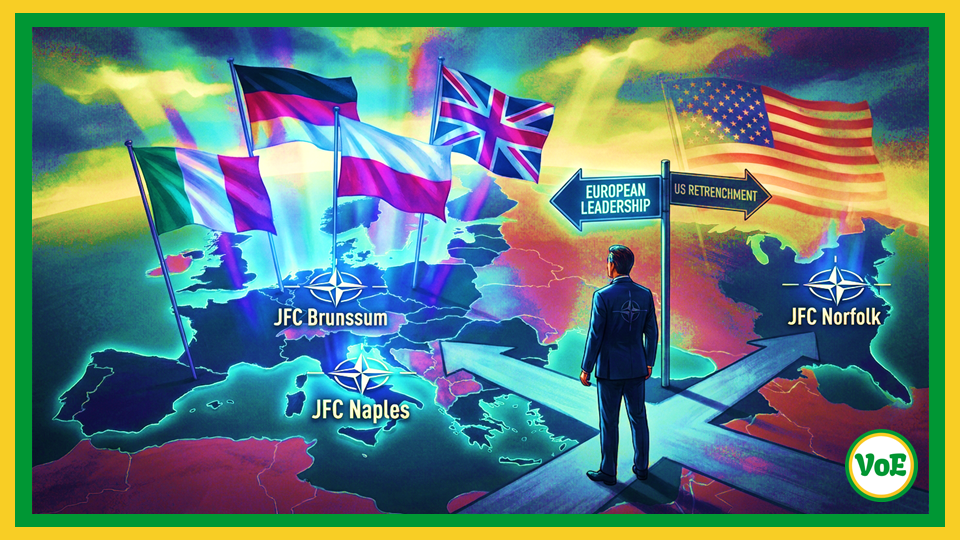
The news that NATO will gradually shift two Joint Force Commands from the United States of America to European leadership is not getting all the attention it deserves. The decision reportedly follows US President Donald Trump’s renewed pressure on allies to shoulder more of Europe’s own defence burden, with NATO presenting the move as part of a “fairer sharing of responsibility” within the alliance.
In this context, Italy will take over Joint Force Command Naples, while Germany and Poland will rotate leadership of Brunssum, and the United Kingdom will assume command of Joint Force Command Norfolk in Virginia. This means that, once the transition is complete, all three of NATO’s crisis-level operational commands will be under European control. Washington, for now, retains the post of Supreme Allied Commander Europe (SACEUR), still held by an American general.
This shift, for one thing, is more than bureaucratic housekeeping. It comes alongside the Trump administration’s National Defence Strategy, which bluntly emphasizes that NATO allies must take primary responsibility for Europe’s defence as the US pivots toward homeland defence, neo-Monroeism and China deterrence. There have been other signs: in a symbolic enough development, Defence Secretary Pete Hegseth even skipped his first NATO defence ministerial, while Elbridge Colby, the strategy’s lead author, attended instead.
This trend was reinforced days later in Munich, where NATO Secretary General Mark Rutte spoke of a “real shift in mindset” among European allies, highlighting higher defence spending and a willingness to assume leadership roles. According to Rutte, Europe and Canada meeting the 2 percent benchmark, and even discussing a path toward 5 percent, would strengthen rather than weaken the transatlantic bond.
The subtext here is that American disengagement has already taken several concrete forms, ranging from debates over US troop deployments in Europe to the gradual reduction of American staffing inside NATO’s command structures. One may recall that, back in November 2025, the US ambassador to NATO openly suggested Germany should one day assume NATO’s top military role, which, sure enough, raised some eyebrows on both sides of the Atlantic.
German Chancellor Friedrich Merz in turn responded by calling on Europe and the US to “repair and revive transatlantic trust together”. Merz even conceded that US Vice President JD Vance had been “right” to describe a deep rift between the two sides a year earlier, though he warned that Europe need not import Washington’s “culture wars” wholesale (“culture war of the MAGA movement is not ours”). In any case, Merz’s appeal basically rested on the claim that NATO remains as much a US competitive advantage as a European one.
This is precisely where the contradiction lies. As Sara Bjerg Moller of the Centre for a New American Security argues in her recent piece, America cannot simultaneously disengage from NATO and expect to lead it – a typical American stance I often describe as a “having the cake and eating it too” approach. According to Moller, Washington has paused large-scale troop withdrawals after congressional backlash, but it is now pursuing a subtler strategy: relinquishing operational-level command posts and declining to fill US staffing positions at NATO installations. Thereby, the US reduces day-to-day control of alliance planning without formally leaving. This approach may end up proving itself more consequential than removing a brigade or two.
However, Moller stresses that NATO’s command structure was built around US infrastructure, personnel, and nuclear guarantees. In this setting, in practice, those who supply the bulk of the troops also end up holding command authority. If Europeans take over planning and operational roles while US presence thins, pressure will inevitably mount to transfer even the SACEUR post. Yet a non-American issuing operational orders to US forces still remains a Pentagon red line. Thus, Washington risks engineering a system it cannot politically or militarily accept.
The German angle deserves particular scrutiny. Only a few years ago, Germany was widely described as the “sick man of Europe,” grappling with deindustrialization, energy shocks after Nord Stream, and prolonged stagnation. Well, recent economic data suggest that growth remains anaemic and structural problems unresolved. Is Germany — strained enough economically and institutionally as it is — truly positioned to assume NATO’s top military leadership? Or is this expectation more political theatre than strategic planning?
Here, the broader context matters. I have previously written about the increasingly open enmity between Europe and the US, from “burden-shifting” in Ukraine to Greenland threats and beyond.
The current NATO adjustments fit this pattern: Washington, it seems, wants fewer obligations but still retains maximum leverage. That is a blunt ambition, and it is at odds with alliance realities.
Thus, what is the endgame? The Trump administration appears to believe it can offload responsibility while preserving freedom of action. One again, having the cake and eating it too. History suggests things may not work out so simply. As Moller notes, all the leverage, “goodwill”, and global reach derived from alliance leadership far exceed the costs, from an American perspective. A half-withdrawal risks encouraging instability while diminishing US control over escalation and logistics. In other words, one does not simply “leave” NATO leadership.
In the end, NATO’s dilemma mirrors America’s own existential dilemma today. You cannot redesign an alliance built around US power and then pretend the centre can be removed without collapse. In the emerging multipolar world, the overburdened and overextended US cannot possibly remain the global hegemon; and yet, at the same time, it cannot simply renounce that “post”. This contradiction is systemic and Trump’s attempts to overcome (like his “consolidation” strategy) most likely will backfire and increase tensions.
Uriel Araujo, Anthropology PhD, is a social scientist specializing in ethnic and religious conflicts, with extensive research on geopolitical dynamics and cultural interactions.
Disclaimer: The views expressed in this article are author’s own and do not necessarily reflect the editorial policy of Voice of East.
Discover more from Voice of East
Subscribe to get the latest posts sent to your email.
Categories: Analysis, Geopolitics, International Affairs
Related Articles
-
 Rubio’s Munich Manifesto: Civilizationalism And The Architecture Of Trump 2.0’s World Order
-
 Brazil-Russia Nuclear Diplomacy Challenges Washington’s Hemispheric Dominance
-
 Trump 2.0 Must Urgently Declare Its Position Towards Poland’s Nuclear Weapons Plans
-
 A Venezuelan‑Style Iran Oil Blockade Could Let The US Divide And Rule RIC
 Voice of East
Leave a Reply