Why Finnish President Stubb Won’t Convince the Global South to Abandon Multipolarity
This collection of countries, which is unofficially led by India (the most populous and fastest-developing state among them by far), knows that its interests are best served by accelerating the implementation of the Global East’s Neo-Realist multipolar vision.
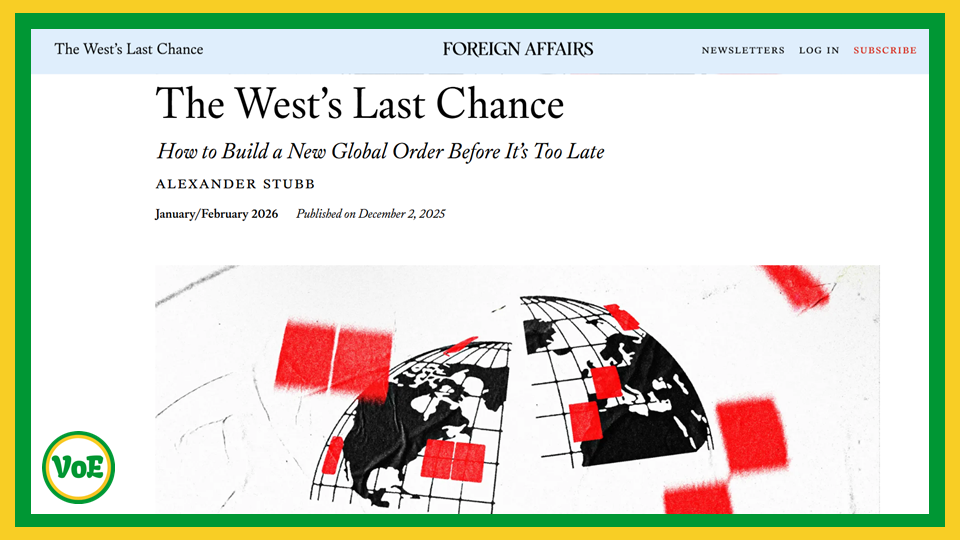
Finnish President Alexander Stubb published a piece at Foreign Affairs, the influential Council on Foreign Relations’ bi-monthly magazine, in December about “The West’s Last Chance: How to Build a New Global Order Before It’s Too Late”. He perceives the world as being divided into three blocs; the US-led Global West, the Chinese-led Global East, and the Global South. The interplay between them will shape the world order, he believes, which will result in either a liberal restoration, persistent disorder, or outright chaos.
This model resembles the one described here in March 2023. The Global South is the kingmaker, but it won’t help restore the declining liberal world order unless the Global West implements systemic reforms by expanding number of permanent UNSC seats, removing their veto power, and updating global trade and financial institutions to make them more representative. In parallel, the Global West should also practice what Stubb calls “values-based realism”, which is his neologism for geopolitical pragmatism.
He describes it as “committing to a set of universal values based on freedom, fundamental rights, and international rules while still respecting the realities of the world’s diversity of cultures and histories.” Stubb elaborated that “The aim of values-based realism is to find a balance between values and interests in a way that prioritizes principles but recognizes the limits of a state’s power when the interests of peace, stability, and security are at stake.”
His “values-based realism” requires implementing the earlier enumerated reforms, improving the Global South’s standard of living, and eschewing aggressive democracy promotion within their societies. All of this is sensible. According to him, “The global West cannot simply attract the global South by extolling the virtues of freedom and democracy; it also needs to fund development projects, make investments in economic growth, and, most important, give the South a seat at the table and share power.”
Likewise, “The global East would be equally mistaken to think that its spending on big infrastructure projects and direct investment buys it full influence in the global South. Love cannot be easily bought.” Another difference that he makes between the two is his claim that the Global West represents multilateralism and the Global East multipolarity, correspondingly described as a “system of global cooperation that rests on international institutions and common rules” and an “oligopoly of power.”
Stubb is just fearmongering about the return of Neo-Realism to International Relations. It’s poised to take the form of civilization-states – those that left lasting socio-political legacies on their neighbours over the centuries – re-establishing their sphere of influence for security-related reasons. The quid pro quo is that they’ll provide for relatively smaller states’ economic interests. This is arguably a fairer and more sustainable system than ruling over them through exploitative institutions per the Neo-Liberal model.
His promotion of “values-based realism”, basically geopolitical pragmatism of the sort that others have already proposed, therefore likely won’t convince the Global South to perpetuate its servitude within the Global West’s Neo-Liberal multilateral system. This collection of countries, which is unofficially led by India (the most populous and fastest-developing state among them by far), knows that its interests are best served by accelerating the implementation of the Global East’s Neo-Realist multipolar vision.
Disclaimer: The views expressed in this article are author’s own and do not necessarily reflect the editorial policy of Voice of East.
Discover more from Voice of East
Subscribe to get the latest posts sent to your email.
Categories: Analysis, Geopolitics, International Affairs
 Cloning, Ukraine Biolabs, And The Epstein Files: The Revelations Western Media Won’t Touch
  What’s Driving The US’ Reported Decision To Re‑Station Tactical Nukes In The UK
  What’s The Likelihood Of A Global Nuclear Arms Race?
  US Neo‑Monroeist Offensive Strangling Cuba Risks Blowback At Home
  Voice of East
Leave a Reply