Why Is The Russian Foreign Ministry Downplaying The Likelihood Of TRIPP’s Implementation?
With all respect to Kalugin and the institution that he represents, nobody is perfect and expectations can sometimes be mistaken, such as was recently the case with the MFA taking Mali’s stability for granted before the West unleashed its preplanned campaign to turn it into Syria 2.0.
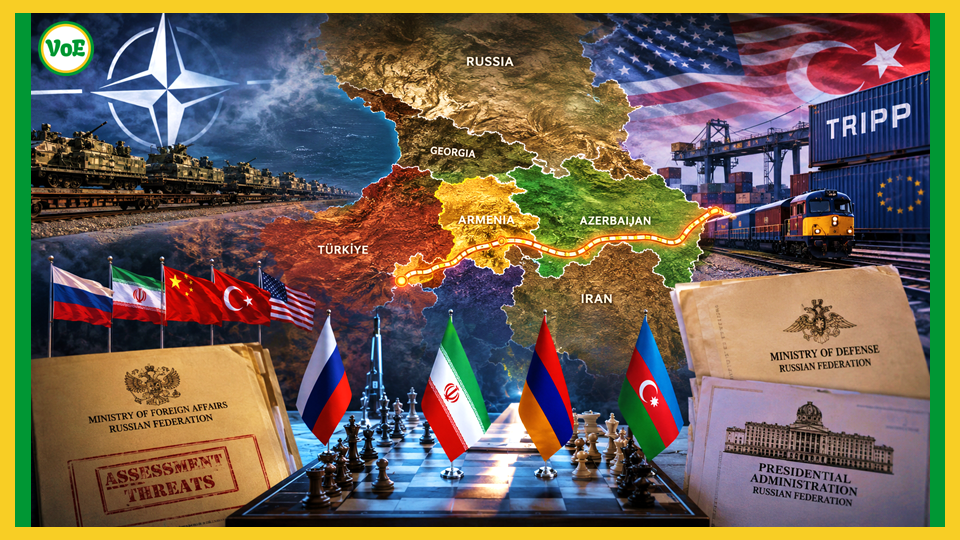
It was recently observed that “The Russian Triad Is Now On The Same Page Regarding Southern-Emanating Threats From NATO” after the Ministry of Foreign Affairs (MFA) followed the Presidential Administration (PA) and Ministry of Defence (MOD) in warning about this. The MOD and MFA specifically touched upon such threats from Central Asia while the PA addressed those from the South Caucasus connected to last August’s “Trump Route for International Peace and Prosperity” (TRIPP).
Central Asian-emanating threats from NATO would only realistically occur upon the implementation of TRIPP in the South Caucasus, however, given this route’s dual role as a NATO military logistics corridor. On the same day that the Director of the MFA’s Third CIS Department told TASS about these South Caucasus-facilitated NATO threats from Central Asia, the Director of the Fourth CIS Department downplayed the likelihood of TRIPP’s implementation in comments that he also shared with TASS.
Mikhail Kalugin implied that Iran might intervene and claimed that China won’t use TRIPP due to it being under US control. Other reasons are “the presence of Russian border guards on the Armenian-Iranian border, the need to build a Russian-standard railway line for a seamless connection with the Azerbaijani one, the concession of South Caucasus Railways JSC to manage the Armenian railway network, which is valid until 2038, and Armenia’s inclusion in the Eurasian Economic Union (EAEU) single customs space.”
In the order that they were mentioned, Iran is unlikely to go to war with Azerbaijan and thus also its mutual Turkish defence ally over TRIPP no matter how much it dislikes this NATO military logistics corridor along its northern border. As for China, Xi just declared a new “constructive strategic stable relationship” with the US during Trump’s trip, so he clearly has no qualms about TRIPP. Its route also optimizes China’s “Middle Corridor” to Europe.
Moving along, Armenia’s seemingly inevitable full defection from the CSTO means that Russia’s guards on the Iranian border will probably be withdrawn, while its seemingly inevitable one from the EAEU means that Armenia will probably renege on its railway concession to Russia too. After all, the US has been tasked with guarding TRIPP, Putin is already openly preparing for a Russian-Armenian “divorce”, and any company – perhaps even an Azeri one – could build the required Russian-standard railway line.
All of these arguments raise the question of why Kalugin downplayed the likelihood of TRIPP’s implementation, which might be due to three reasons that aren’t mutually exclusive. First, the MFA can be optimistic to the point of being naïve, which is a characteristic of its strategic culture. Second, it might want to signal to Russia’s supporters that “everything is under control”, while the third reason could be that it hopes that Armenian media will report on Kalugin’s comments for influencing locals’ views of TRIPP.
With all respect to Kalugin and the institution that he represents, nobody is perfect and expectations can sometimes be mistaken, such as was recently the case with the MFA taking Mali’s stability for granted before the West unleashed its preplanned campaign to turn it into Syria 2.0. Likewise, downplaying the likelihood of TRIPP’s implementation risks creating false expectations among Russian policymakers, which can lead to the formulation of policies that fail to improve Russia’s acute strategic predicament.
Disclaimer: The views expressed in this article are author’s own and do not necessarily reflect the editorial policy of Voice of East.
Discover more from Voice of East
Subscribe to get the latest posts sent to your email.
Categories: Analysis, Geopolitics, Russia
Related Articles
-
 The Ukrainian Conflict Is Back In Focus As Russian Troops Steadily Advance
-
 Lavrov vs. Rubio: Who’s Telling The Truth About The “Spirit Of Anchorage”?
-
 Ukraine’s Long-Range Strikes On Russia Are More Showmanship Than Strategy
-
 Lavrov’s Realization That Anchorage Only Bought Time For Ukraine To Rearm Was Long Overdue
 Voice of East
Leave a Reply